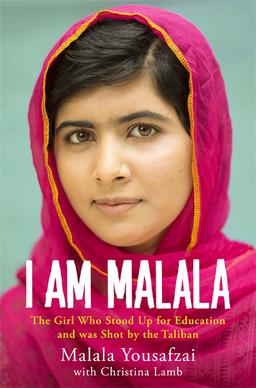

Audiobook narrated by Archie Panjabi, with a prologue narrated by the author, Malala
“We were learning how to struggle. And we were learning how strong we are when we speak.“
I’m not usually a memoir person; I’m not particularly interested in reading the results of ghostwritten cash grab celebrity book deals. This is my third memoir in six months – probably as many as I read in the six years prior.
My general rules for memoirs are:
- The author has to have a genuinely fantastic story to tell. Being famous or good at sport doesn’t count.
- The author must be a talented writer who has written the memoir themselves. If they are not a writer, they should get a biographer.
Funnily enough, I Am Malala is technically a partially ghostwritten celebrity memoir – but as a bona fide twenty-first century teenage heroine producing a book for publication in her non-native language, Malala gets a pass.
I downloaded this book after hearing Malala in an interview on the Louis Theroux podcast. I had also recently been doing some reading to help with a fundraiser for the charity Educate Girls, which led me to the Malala Fund. I was intrigued to learn more about Malala’s story and this young woman who is impossible not to admire and adore. Malala is, of course, ‘the girl who was shot in the head by the Taliban’, for campaigning for girls’ education.
I Am Malala recounts the author’s childhood, growing up in Pakistan’s Swat Valley in the mountainous northern region. Her village was a small traditional one, not prosperous but not desperately poor. It was a region of natural beauty that drew tourists but was prone to floods and natural disasters. The greatest disaster of all was the arrival of the Taliban, who began to take hold in the mid-2000s in the wake of the Afghanistan war. Militants driven from Afghanistan took up residence in the mountains of Swat and began growing a local movement.
The book covers Malala’s life up to her shooting and the immediate aftermath, with a chapter devoted to reflecting on her new life in Birmingham, where she and her family had to hastily set up a new life while she received extensive medical treatment following the shooting. The family did not know at the time that they would never return home to Swat.
Through the lens of her own experience, Malala gives a history of the region and how the Taliban took hold in the Swat Valley, filling the vacuum created by an ineffective government and legal system. She outlines the populist campaign that used a local radio station to gain a following of a certain brand of conservative Islam, only to become more and more extreme over time. The diversity of religious practice and belief in the area made it an ideal breeding ground for the Taliban’s divisive tactics.
Malala’s father was an outspoken progressive supporter of women’s empowerment and education who set up the local school Malala attended. But not all the locals were on board with this agenda. Even as Malala describes how she delighted and excelled in her studies, championed by her father, she tells of a classmate who was pulled out of school and married off at age eleven, never to be seen again.
The Taliban’s growing presence unfolds like a nightmare. Suddenly girls are being whipped in the street for supposed indiscretions as onlooking family members step in to help (with the whipping). When Malala was eleven, the Taliban announced a ban on girls’ education and gradually stripped women of all the rights and freedoms she and her father had fought for.
I Am Malala is narrated with a kind of ‘as told to’ feel. It has no exceptional literary quality; that’s not the kind of book it is. The writing is unadorned and straightforward. It feels just like the author is sitting across from you in an armchair, telling you what happened. This style makes the book especially well suited to the audiobook format, and Archie Panjabi does an excellent job of the narration – so good I had to remind myself it wasn’t Malala’s own voice.
It feels necessary here to mention the book’s co-author, Christina Lamb, an award-winning foreign correspondent. It is a credit to this co-author how well she retained Malala’s voice throughout and resisted any temptation to polish the prose and make it more sophisticated. It’s the authenticity of Malala’s youthful voice that makes the book cut as deep as it does. We see all this horror unfolding through the eyes of a child, and the adults who actively or passively enable the reign of terror, while children are made into targets.
The book is based partly on a regular column Malala wrote for BBC Urdu while still living in Pakistan under the Taliban, and partly on lengthy interviews with Christina Lamb. Lamb did an excellent job with the book’s structure, balancing political and historical context with Malala’s campaigning work and her surprisingly normal everyday life: studying, playing on rooftops, arguing with her best friend, playing and fighting with her brothers, and reading books.
The first half of the book reminds us that Malala is just one among many thousands of victims of this regime. This is not to take anything away from her exceptional bravery, passion and activism, but it is a useful reminder of what she is still fighting for.
The last part gives a sense of the refugee experience. Her family settles into their new home in Birmingham, courtesy of the British Government. They feel safe there but still jump at loud noises and have to be taught how to use the mysterious apparatuses installed in their new house – the oven, the TV, the washing machine. They are fortunate, but they are strangers in a foreign land.
“We miss everything, even the smelly stream. My father says, ‘If I had known this would happen, I would have looked back for a last time just as the Prophet did when he left Mecca to migrate to Medina. He looked back again and again.’‘”
The podcast interview that first encouraged me to pick up this book, many years after publication, was part of a press tour for Malala’s new book – a second memoir called Finding My Way, which deals with her life in England, the second phase of her young life, split between the ordinary teenage experience and being a global celebrity, charity director and political figure.
Malala is refreshingly open about the fact that this hasn’t been an easy road. While she has recovered from the physical and mental trauma of the shooting and learned how to navigate the experience of being a refugee and minority in her new home, as an international figure she still deals with criticism from conservatives back home who berate her for dressing too immodestly or engaging in Western activities. She can now safely visit the major cities of Pakistan, but doesn’t know when or if she will ever be able to return to the home of her childhood. While I probably won’t rush to read the new memoir, the interview served as a fascinating epilogue for someone who published the story of her life at age 16.
I find it difficult to judge this book by the usual metrics. It is compelling and highly readable. It’s not a great work of literature, but nor should it be. Malala says she was inspired by The Diary of Anne Frank and, like that book, her memoir is important not because of how good it is, but because of what it bears witness to. It is the story of one girl, through which we can imagine the lives of so many others for whom life took different turns.
It’s a testament, a witness statement that forces us to confront not only the horror of the Taliban – which is not so difficult – but also the part our own government and allies played in this story, with the drone strikes and the campaigns that pushed these militants over the border into Swat and took no responsibility for the consequences. That part is harder to reckon with.


Leave a Reply