
“We all love to instruct, though we can teach only what is not worth knowing.”
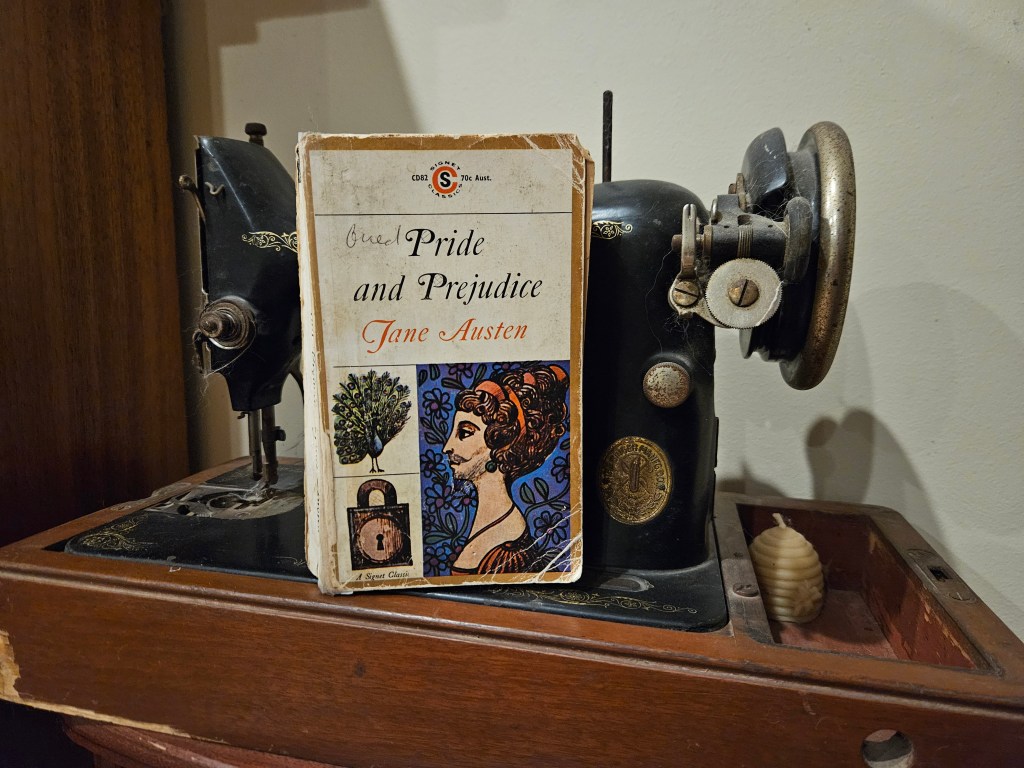
I, too, was shocked and horrified to find that I had never in all my years read Pride and Prejudice. Considering I can quote the BBC series practically by heart, it’s surprising but also maybe makes some sort of sense that I haven’t read the book. Though I’m an avid fan of a well-made Austen screen adaptation, I had mentally placed her in the rare category of authors whose work is better with the edit that the screen adaptation requires (looking at you, J.R.R Tolkien, and bracing for hate mail – or I would be, if this blog had any readers.)
I read Northanger Abbey as a teenager and enjoyed it but wasn’t left itching for more. I read Persuasion in my early 20s and enjoyed it, but found it a little overlong and slow. At some point I made a start on Sense and Sensibility, only to give up after what felt like six pages of introduction listing out every character and how many thousand a year.
A Penguin Classics podcast I listened to recently about Jane Austen convinced me that by only watching the adaptations you’re missing out on a lot of nuance and texture. I decided it was time to try another Austen classic in its original form.
Unlike Sense and Sensibility, Pride and Prejudice wastes no time on arduous scene-setting, getting straight to the point with its famous opening line and snappy dialogue. It was a strange reading experience as I hadn’t realised just how much of the dialogue from the series is taken more or less directly from the book.
I found myself wishing I could have read it first, as it was impossible not to hear the words in the voices of the actors from the series and see their faces as I read. Much like the experience of listening to A Christmas Carol and finding the lines delivered in my head by Muppets.
This book, unlike Persuasion, had very little fat to cut and most of it did make its way into the BBC series. Still, I found it was true that the book offered (even) more than the screen adaptation.
Pride and Prejudice is, like all Austen’s works, a romance and amusing social commentary. In fact, though it’s not entirely true, I always think of Austen as more or less the inventor of the rom-com.
Elizabeth is the lively and strong-willed second daughter of a gentleman whose estate is to fall out of the family’s possession once he dies, leaving his wife and five daughters with very little to live on. Mr Darcy is the conceited inheritor of a grand estate, an echelon above Elizabeth in wealth and standing but much her inferior in pleasantness of demeanour.
In the Penguin podcast with novelist Monica Ali, which I highly recommend, it’s mentioned that despite her status as a romance writer, Austen wasn’t much of a romantic herself. Ali notes that while things always work out for the heroine, all around her can be seen the wreckages of other couples. Even the happy couple is always left at the altar, she says; the author cannot seem to bear to follow them into the complications of shared domesticity,
By some combination of this insight, a bit more life experience and the additional context found in the details left out of the series, I found myself thinking about certain situations differently as I read, or understanding them better.
The change in Elizabeth’s feelings towards Darcy never quite sat right with me before, but the book explored in more detail the lengths he had gone to intervening in her sister Lydia’s disgraceful elopement. The social context provided by the full text also shed more light on the extent of this disgrace, and the sacrifice Darcy made in getting involved in it, and being willing to marry Elizabeth despite the distaste this circumstance added to her inferior social status and wealth.
Other aspects of the story that had always puzzled me, like Charlotte Lucas’s pragmatic decision to marry the odious bore Mr Collins, made a bit more sense. I found myself for the first time surprised by Elizabeth’s determination to marry for love alone, with seemingly no concern for the risk she took in securing a comfortable future for herself and her mother and sisters, despite her own concession that ‘one of us at least will have to marry very well.’ In turning down Darcy’s initial, very unromantic offer, she gambled with her family’s future, hoping that some other more agreeable man of fortune would come along to woo her, or that one of her sisters would pick up the slack.
Fortunately for all of us, she got her second chance with the man who showed an almost inhuman willingness to improve himself to earn her regard.
In better understanding the social fabric of the day, the expected standards of behaviour and the narrator’s gentle judgement of those whose manners were found wanting, I was also struck by our heroine’s own unusualness. Though her outspoken and outdoorsy ways, her egalitarian beliefs and allergy to snootiness seem perfectly normal by modern standards, within her own society, Lizzie borders on eccentric. Her ideas verge on revolutionary, yet she presents them with such sense and decorum that the author insists on their being taken seriously. I’d always admired Austen’s wit, character and dialogue, but I think it was this sudden understanding of how she so elegantly and subtly overturns expectations of what women should be, and the validity of class-based hierarchies, that made me appreciate why she has earned a place with the all-time greats.
“It’s like this corseted rage. It’s all very polite, it’s all very genteel, but I can feel this absolute rage that she has.“
– Monica Ali
I find it very difficult in some ways to to judge the writing craft in the way I usually try to think about it. Firstly because it was written in an era when the expectations of a novel were so completely different, when words had different meanings and conventions were unrecognisable from today (I was interested to see that even my copy, which required some interpretation, was itself a reworked edition with some modernised language, grammar and punctuation). Secondly because who am I to judge what is commonly considered the finest work of an author widely regarded as among the greatest ever to put pen to paper in the English language?
I will make instead some observations.
I was surprised by the balance of scene and summary in this novel. I’m sure some of this is down to the gradual shift towards a more cinematic scene-based narrative style since 1813 when this was published, but even compared to other novels of its day I felt there was more ‘telling’, more narrative summary than I was used to.
In the crucial moment when Elizabeth and Darcy finally declare their mutual feelings, the author seems to shy away and instead of finding the perfect line of dialogue to bring butterflies to her readers’ stomachs, Austen pulls back and just gives the gist of what was said. Given her excellence as a writer of dialogue, I was intrigued by her decision to not write dialogue in certain circumstances such as this one.
I was also fascinated by the ready use of italics for emphasis. A modern editor would likely strike through all these, telling the writer to reconsider their word choice instead of letting formatting carry meaning. It felt like a reminder that many ‘rules of writing’ (just like ‘show don’t tell’) are often more about following the current trend than any real good/bad binary.
I didn’t find the elegance of prose that I usually look for in a novel – in fact, reading Pride and Prejudice felt at times oddly like reading a play. But it would be unfair to compare Austen’s prose to that of Dickens; she’s a different kind of writer altogether. Her work is less about vivid descriptions and turns of phrase than about the sharp wit, observation of character and wonderfully tense and revealing exchanges of dialogue.
This, I expect, is what has lent her stories so exceptionally well to the screen in ways that continue to be highly relevant and relatable even after so much else has changed – because in the past two centuries, not that much has changed about human nature.
In her characters we recognise the people in our own lives, ready to be loved and laughed at – flawed, contradictory, superficial and self-indulgent – just in finer clothes, with stuffier patterns of speech.