
Author: scrthomson

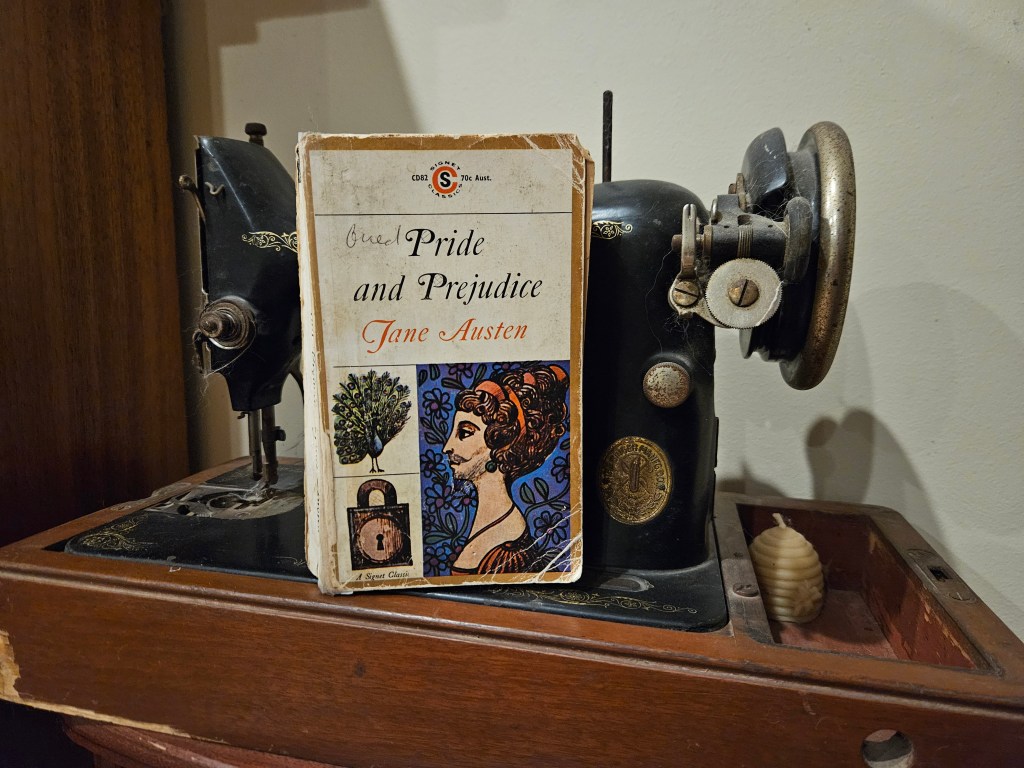
  • Pride and Prejudice – Jane Austen

    Pride and Prejudice – Jane Austen

    a book symbol, denoting a physical copy read

    “We all love to instruct, though we can teach only what is not worth knowing.”

    I, too, was shocked and horrified to find that I had never in all my years read Pride and Prejudice. Considering I can quote the BBC series practically by heart, it’s surprising but also maybe makes some sort of sense that I haven’t read the book. Though I’m an avid fan of a well-made Austen screen adaptation, I had mentally placed her in the rare category of authors whose work is better with the edit that the screen adaptation requires (looking at you, J.R.R Tolkien, and bracing for hate mail – or I would be, if this blog had any readers.)

    I read Northanger Abbey as a teenager and enjoyed it but wasn’t left itching for more. I read Persuasion in my early 20s and enjoyed it, but found it a little overlong and slow. At some point I made a start on Sense and Sensibility, only to give up after what felt like six pages of introduction listing out every character and how many thousand a year.

    A Penguin Classics podcast I listened to recently about Jane Austen convinced me that by only watching the adaptations you’re missing out on a lot of nuance and texture. I decided it was time to try another Austen classic in its original form.

    Unlike Sense and Sensibility, Pride and Prejudice wastes no time on arduous scene-setting, getting straight to the point with its famous opening line and snappy dialogue. It was a strange reading experience as I hadn’t realised just how much of the dialogue from the series is taken more or less directly from the book.

    I found myself wishing I could have read it first, as it was impossible not to hear the words in the voices of the actors from the series and see their faces as I read. Much like the experience of listening to A Christmas Carol and finding the lines delivered in my head by Muppets.

    This book, unlike Persuasion, had very little fat to cut and most of it did make its way into the BBC series. Still, I found it was true that the book offered (even) more than the screen adaptation.

    Pride and Prejudice is, like all Austen’s works, a romance and amusing social commentary. In fact, though it’s not entirely true, I always think of Austen as more or less the inventor of the rom-com.

    Elizabeth is the lively and strong-willed second daughter of a gentleman whose estate is to fall out of the family’s possession once he dies, leaving his wife and five daughters with very little to live on. Mr Darcy is the conceited inheritor of a grand estate, an echelon above Elizabeth in wealth and standing but much her inferior in pleasantness of demeanour.

    In the Penguin podcast with novelist Monica Ali, which I highly recommend, it’s mentioned that despite her status as a romance writer, Austen wasn’t much of a romantic herself. Ali notes that while things always work out for the heroine, all around her can be seen the wreckages of other couples. Even the happy couple is always left at the altar, she says; the author cannot seem to bear to follow them into the complications of shared domesticity,

    By some combination of this insight, a bit more life experience and the additional context found in the details left out of the series, I found myself thinking about certain situations differently as I read, or understanding them better.

    The change in Elizabeth’s feelings towards Darcy never quite sat right with me before, but the book explored in more detail the lengths he had gone to intervening in her sister Lydia’s disgraceful elopement. The social context provided by the full text also shed more light on the extent of this disgrace, and the sacrifice Darcy made in getting involved in it, and being willing to marry Elizabeth despite the distaste this circumstance added to her inferior social status and wealth.

    Other aspects of the story that had always puzzled me, like Charlotte Lucas’s pragmatic decision to marry the odious bore Mr Collins, made a bit more sense. I found myself for the first time surprised by Elizabeth’s determination to marry for love alone, with seemingly no concern for the risk she took in securing a comfortable future for herself and her mother and sisters, despite her own concession that ‘one of us at least will have to marry very well.’ In turning down Darcy’s initial, very unromantic offer, she gambled with her family’s future, hoping that some other more agreeable man of fortune would come along to woo her, or that one of her sisters would pick up the slack.

    Fortunately for all of us, she got her second chance with the man who showed an almost inhuman willingness to improve himself to earn her regard.

    In better understanding the social fabric of the day, the expected standards of behaviour and the narrator’s gentle judgement of those whose manners were found wanting, I was also struck by our heroine’s own unusualness. Though her outspoken and outdoorsy ways, her egalitarian beliefs and allergy to snootiness seem perfectly normal by modern standards, within her own society, Lizzie borders on eccentric. Her ideas verge on revolutionary, yet she presents them with such sense and decorum that the author insists on their being taken seriously. I’d always admired Austen’s wit, character and dialogue, but I think it was this sudden understanding of how she so elegantly and subtly overturns expectations of what women should be, and the validity of class-based hierarchies, that made me appreciate why she has earned a place with the all-time greats.

    “It’s like this corseted rage. It’s all very polite, it’s all very genteel, but I can feel this absolute rage that she has.“
    – Monica Ali

    I find it very difficult in some ways to to judge the writing craft in the way I usually try to think about it. Firstly because it was written in an era when the expectations of a novel were so completely different, when words had different meanings and conventions were unrecognisable from today (I was interested to see that even my copy, which required some interpretation, was itself a reworked edition with some modernised language, grammar and punctuation). Secondly because who am I to judge what is commonly considered the finest work of an author widely regarded as among the greatest ever to put pen to paper in the English language?

    I will make instead some observations.

    I was surprised by the balance of scene and summary in this novel. I’m sure some of this is down to the gradual shift towards a more cinematic scene-based narrative style since 1813 when this was published, but even compared to other novels of its day I felt there was more ‘telling’, more narrative summary than I was used to.

    In the crucial moment when Elizabeth and Darcy finally declare their mutual feelings, the author seems to shy away and instead of finding the perfect line of dialogue to bring butterflies to her readers’ stomachs, Austen pulls back and just gives the gist of what was said. Given her excellence as a writer of dialogue, I was intrigued by her decision to not write dialogue in certain circumstances such as this one.

    I was also fascinated by the ready use of italics for emphasis. A modern editor would likely strike through all these, telling the writer to reconsider their word choice instead of letting formatting carry meaning. It felt like a reminder that many ‘rules of writing’ (just like ‘show don’t tell’) are often more about following the current trend than any real good/bad binary.

    I didn’t find the elegance of prose that I usually look for in a novel – in fact, reading Pride and Prejudice felt at times oddly like reading a play. But it would be unfair to compare Austen’s prose to that of Dickens; she’s a different kind of writer altogether. Her work is less about vivid descriptions and turns of phrase than about the sharp wit, observation of character and wonderfully tense and revealing exchanges of dialogue.

    This, I expect, is what has lent her stories so exceptionally well to the screen in ways that continue to be highly relevant and relatable even after so much else has changed – because in the past two centuries, not that much has changed about human nature.

    In her characters we recognise the people in our own lives, ready to be loved and laughed at – flawed, contradictory, superficial and self-indulgent – just in finer clothes, with stuffier patterns of speech.

  • The Fifth Season – N.K. Jemisin

    The Fifth Season – N.K. Jemisin

    Audiobook narrated by Robin Miles

    “You certainly weren’t expecting to have to deal with the end of the world, on top of everything else.”

    In the Stillness, apocalypses are not especially abnormal. Planet-wide cataclysms called ‘Seasons’ occur every few centuries, caused by volcanic or seismic activity or some other major environmental change. Each Season deeply alters, or even wipes out, large portions of human life. A Fifth Season is an extended winter, lasting over six months.

    The land is a character in The Fifth Season: a living, breathing, gaseous, occasionally rageful mass to whose whims and tantrums its inhabitants are subject. There are people who can control this land, manipulate its seismic, thermal and kinetic energy to quell or enhance seismic activity.

    While you would think these people would be prized for their land-calming abilities, not everyone who has this power uses it well or wisely or with appropriate training and control. Hence ‘orogenes’ are reviled and feared throughout the land. They live in hiding, in perpetual danger, or else within the Fulcrum, where orogenes are trained into servitude.

    Of course, this is a story about orogenes. Three orogenes in particular, on three journeys.

    Damaya is a young girl taken from a neglectful family to be trained in orogeny at the Fulcrum. There she will learn to control her powers and use them in service to its Guardians.

    Syenite is a recent Fulcrum graduate who is sent on a mission together with a powerful alumnus. They are given a dual purpose: to investigate a mysterious occurrence in a coastal settlement, and to procreate. The Fulcrum needs more orogenes to train.

    Essun is on her way to find her husband and daughter. She wants to bring the daughter safely home and kill the husband who took her, after murdering their son.

    This is not a happy book.

    The Fifth Season and its two sequels have gained high status in fantasy circles, all three winning Hugo Awards. But the genre is actually hard to define: it straddles science fiction, fantasy and dystopia, but doesn’t quite fit the conventions of any one of those, and reads more like literary fiction. It may be the first book I’ve read with the official designation of ‘science fantasy’. First and foremost it’s a study of humanity.

    There’s a gentleness to the style that belies the content. This is a book full of rage, disappointment, cynicism, nihilism, fear, loathing, oppression: a display of the very worst humanity has to offer, and not much in the way of redemption. It’s beautiful and terrible and not an easy read.

    Rescued from her miserable family existence, Damaya’s ‘Hogwarts moment’ is short-lived. Her new Guardian is gentler, kinder, more attentive to her needs, more respectful of her humanity, and also much more sinister than the family she left behind. Once at the Fulcrum, she has only to play the good student and survive. She has no friends, no purpose, no dreams and no vision for the future.

    Syenite is jaded, probably depressed, as is her travelling companion, Alabaster. Effectively slaves to the Guardians, their lives are almost entirely devoid of meaning or pleasure. They dutifully and joylessly attempt to conceive the child together that the Fulcrum requires, enjoying neither the process nor each other’s company.

    Essun is the only one of these characters with any agency. Unlike the other two, who spend most of the story doing what they are told, she is driven by her own powerful purpose. Kill husband. Find daughter.

    There is much to commend in The Fifth Season. Jemisin’s lilting prose has an absorbing quality. Her observance of human nature, particularly of the darker aspects, is deeply moving. Damaya’s Guardian, Schaffa, is drawn with bone-chilling perceptiveness and subtlety. The contrast between his manner and his nature is wonderfully executed in a perfect portrait of coercion. He tells Damaya he loves her. He tells her she’s special. He tells her he will look after her – as long as she does everything he says. He is not quite evil; he just serves a higher purpose, as does everyone at the Fulcrum.

    Themes of otherness, of persecution, of freedom and identity are elegantly explored. The way Jemisin brings the three stories together right at the end of the book is mind-bogglingly clever, and almost made me want to turn right back to the start and re-read it all with a new lens. The reading (listening) experience was strangely mesmerising, like a slow current that sweeps you up and carries you along. But once deposited on the shore, I wasn’t quite sure how I got there or how to feel about the journey.

    Jemisin didn’t give herself an easy task. How to keep readers immersed in a book so full of darkness and despair? She does an impressive job of making the darkness beautiful enough to be compelling. Still, for a book so character-driven, I wanted to be more invested in those central characters – to identify with them, to hope and fear for them, to become them – but I somehow felt them always to be kept at arm’s length.

    Unusually, I found myself becoming less interested in the story as it progressed. Though many fans clearly disagree, I felt it failed to capitalise on the potential of an enthralling setup. Plot development was slow and meandering, and while I was fine with this being a more ‘literary’ fantasy read, there were plot-promises that could have been much more satisfactorily resolved, elevating the story and giving the characters more opportunity to develop.

    I feel bound to add some qualifiers to these criticisms, though, which have to do with my ‘reading’ it in audio format. While the narration by Robin Miles was done well (albeit with an American accent, have I mentioned this should be banned?), I reflected afterwards that this is not a book that lends itself well to audio. I often turn to audio for fantasy reads as they tend to be more plot-forward, but this is not a plot-forward book. I found over time that those small moments of inattention while multi-tasking or drifting off to sleep were detrimental to my understanding of the world Jemisin was building, the subtleties conveyed in the readings of the lore that are interspersed every few chapters, and exactly how things were tied together.

    It was, in fact, only after finishing the book, trying to write this review and realising I was somewhat confused about the details of the Seasons, the Stillness and the lore of the book’s universe that I learned the audiobook in fact comes with an accompanying PDF that includes the appendix and glossary that go with the text version. Even so, the audio version doesn’t include the map from the physical book, which shows the supercontinent of the Stillness with all the tectonic plates and faultlines and the places that make up the journeys of the different characters. As fantasy aficionado knows, any great fantasy book must be in want of a map and a glossary, so I couldn’t help feeling I’d missed out on the proper experience.

    I suspect I would have enjoyed the book more in physical form; I would have been more immersed, paid closer attention and appreciated more of the detail. This isn’t a book that grabs you by the horns and doesn’t let go. It reins you in and leads you gently, but you have to watch your footing and follow closely.

    Even so, I find it hard to know how to judge this book which was so impressive and such a work of beauty, and yet left me insufficiently engaged as to be unsure whether to continue the series. It’s an odd thing to say after reading only book one of three, but I’m tempted to suggest The Fifth Season might have worked better as a standalone book with a more tightly structured plot. Plot-wise, at the end of book one, I had no real sense of what books two and three were heading towards.

    Trilogies are for epic quests and characters you want to call in sick to work to spend more time with. The Fifth Season had the kind of pleasant dreaminess that accompanies a bad cold: there’s something nice about being huddled in a blanket on the couch in a kind of alternate state, but it’s not one you’re left in a hurry to re-enter.

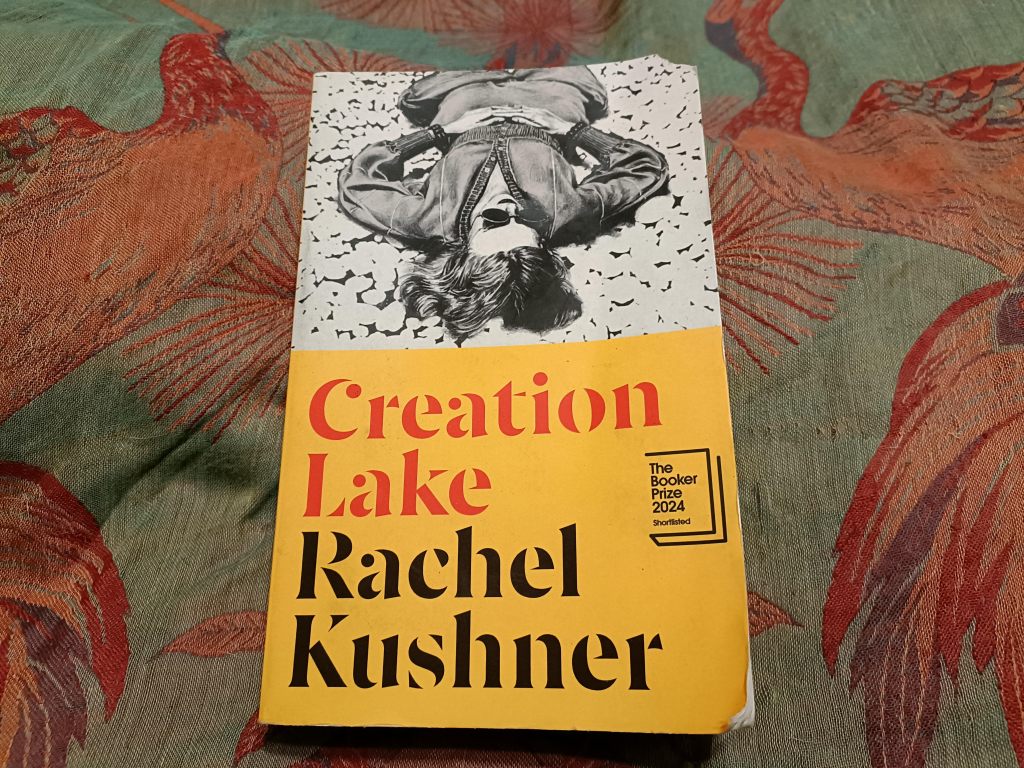
  • Creation Lake – Rachel Kushner

    Creation Lake – Rachel Kushner

    a book symbol, denoting a physical copy read

    “There was an emptiness to her. A sense her lack of affect went all the way down.”

    As usual, I’m in catch-up mode. It seems to be a rule of getting older that time passes more quickly each year, so I shouldn’t have been so shocked to find that the Christmas book I was finally getting to was not from last Christmas, but two Christmases ago.

    As part of the annual Christmas shopping assignment, I had perused the Booker Prize shortlist for the year in search of compelling titles for the people in my life who are destined to unwrap only books from me, year after year after year. It’s now reached the not-unhappy point where the recipient bookshelves are so overflowing, I sometimes receive the book back immediately after it’s been read. Have I cracked the Christmas code? I think so.

    1. Spend time reading about books
    2. Spend time in bookshops, buying books
    3. Avoid any form of online shopping or crowded malls
    4. Receive the gifted books back as freebies, to stack on my own overflowing shelf

    While I didn’t find anything in the shortlist that year that seemed to fit the reading patterns of my intended recipients, Creation Lake caught my attention – it sounded like a fun read, unusually so for the Booker list, which often tends more towards war, famine and broken families. My husband happened to be on the same wavelength, and bought it for me.

    So finally I got started on Creation Lake, which had been emanating waves of enticement from my shelf for the last year and a half. The jacket advertises it as a kind of spy novel with some depth: the story of a cynical American undercover agent who is sent to infiltrate a commune of eco-activists in rural France and finds herself becoming seduced by the philosophy she sneers at. What’s not to like?

    Well, that might depend on the expectations you hold of the novel form. The jacket is not incorrect, but I did find it somewhat deceptive. The spy novel genre is typified by fast-paced action, tension and high stakes. As a Booker shortlist title, I was expecting Creation Lake to have the tension and drama of a spy novel, combined with the compelling ideas and well-crafted prose that standard genre novels sometimes lack. Ideas and good writing are aplenty in this book; tension and drama, not so much.

    An endorsement from Bret Easton Ellis inside the front cover reads, ‘I kept thinking, “this can’t possibly work”, and yet it kept working.’ I can’t say I entirely agree. What I can say about Creation Lake is that I can see it working for some people.

    If you’re the kind of person who likes ‘thinking novels’ and doesn’t care too much for character development or plot, you might not mind that there is essentially only one character in the novel. You might not mind spending 400 pages inside the head of jaded, hollowed-out first-person narrator, while peripheral characters flit around the edges and the plot meanders along like a Neanderthal who’s in trouble with his mate and in no hurry to return to the cave.

    Neanderthals, or ‘Thals’ are very present in this book, while also being fairly irrelevant. Approximately half the book is made up of emails from a kind of cave-influencer called Bruno Lacombe, who has forsaken the ills of modern life (apart from email) in order to live a solo existence in a cave that contains remnant clues of Neanderthal occupation. He reflects deeply on the early history revealed by the caves and the relics found within, including a focus on the misunderstood Neanderthals, who were surely much more advanced and clever than we vain sapiens want to give them credit for.

    Bruno sends long emails outlining his theories on the homos neanderthalensis and sapiens to a commune set up within the ancient Guyenne province in southwestern France. Its inhabitants are seeking reconnection with the old ways, embracing the traditional farming way of life and communal living, rejecting modern capitalism and technological advance.

    This is the commune Sadie, our anti-hero, has been sent to infiltrate by her mysterious and shady employers. By hacking into the emails, she’s learning all she can about this group of hippie eco-activists who are opposing a large-scale megabasin in the region that they feel will threaten the rural economy, traditions and way of life. And who must be prevented from causing any trouble to the corporate overlords who have a vested interest in the project going ahead.

    There’s plenty to chew on in this story; it’s just somehow not the meat I was expecting or hoping for. The premise as outlined above offers so much, but delivers very little excitement. There is much philosophising on human history, evolution, culture and society; reflections on change and progress, on the inevitable march of technology into these rural communities that still look much like they did in the 1200s, but with petrol cars and iPhones.

    There is some excellent observation on class: the core of this commune of radical reactionaries is made up of wealthy private-school boys, who are all too willing to leave the grunt work and childminding to the women while they do the intellectual work in the library, writing theses on the livelihoods of the peasants they, outsiders from the big city, claim to represent, but whose gruff manners and xenophobia (or downright racism) they deplore.

    “I kept my face blank, to suppress my amusement. Refined and Parisian Alexandre had never been forced to associate with the sort of lower-class white people who might feel threatened, if misguidedly, by immigrants and nonwhites.”

    I enjoyed mulling over these concepts, which are explored through Bruno’s emails combined with Sadie’s sharp observations. But it left me wondering, was a novel really the best form for this book? If the author wanted to write a treatise on human history and culture, on the way technology and progress butt up against rural traditions and our seemingly-increasing desire to retreat to simpler times, this might have been done better in a non-fiction format. I felt I was learning a lot about human and pre-human history, but as told by an unreliable narrator in a novel, and so, as knowledge, practically worthless. As a book, Creation Lake has many strengths. As a novel, it has many weaknesses.

    It’s always a challenge to write an unlikeable protagonist. Sadie is basically an empty shell. She sneers at the proletariat and intellectual classes alike. She drinks and drives. She reflects without introspection on the young boy she entrapped and sent to jail in her previous job. She sleeps with a man she despises (for the sake of her cover) and another who is otherwise engaged (just for fun). I agree with Bret Easton Ellis insofar as it’s incredible Creation Lake works as well as it does.

    Sadie and the basic plot and the ideas contained within are just engaging enough. There’s never a sense of high tension or of anything much being at stake. Sadie’s observations are humorous, but she’s by no means enough of a riot to be good company despite her failings. Bruno’s emails are paraphrased through Sadie’s reading voice, instead of written out in full, which further intensifies the stifling sense of being trapped inside this amoral, soulless void of a person.

    Similarly, there is minimal dialogue. The dialogue that does appear is often either oddly unnatural, over-polished and quip-like, or overly summarised and workmanlike, giving information instead of revealing character or creating tension. Not only does Sadie never get close to anyone, she never even really pretends to. Apart from the expected late-stage change of heart, there is very little character development or relational tension. It’s as if not only the protagonist, but the author herself, is a misanthrope who would rather spend as little time with other humans as possible.

    I never felt like giving up on the book, but I did feel frustrated with it – especially when I found myself more than three-quarters of the way through and realised the plot had not progressed at all. Perhaps the best aspect of the reading experience was that, dismayed by my lack of progress, I committed to spending a lot more time reading, so I could get through it faster and onto the next book. I reinstated mandatory bedtime reading, which for too long has been classed as a luxury or an audio-only venture (which basically means rewinding to the same spot every night before immediately drifting off).

    I found the more I forced myself to read Creation Lake, the more I enjoyed it. But that maybe says more about the act of reading than the book itself.

    I enjoyed the setting in rural France; the book has such a European sensibility it’s hard to believe the author is American (she is also, from her cover photo, the most European-looking American to have ever lived). I enjoyed the philosophising and the snarky commentary and the essentially irrelevant side-expeditions about random local residents and Neanderthals alike.

    When I finished, I was glad to have read it, but didn’t feel it justified the opportunity cost of lost reading time for better books. Ultimately, I felt that the novel, like its protagonist, suffered from empty-shell syndrome: it has flesh on its bones, but no identifiable heart.

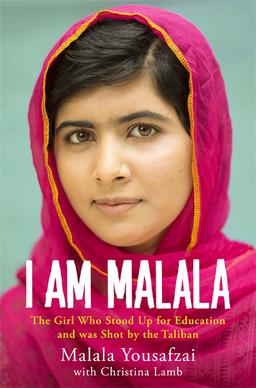
  • I Am Malala – Malala Yousafzai and Christina Lamb

    I Am Malala – Malala Yousafzai and Christina Lamb

    Audiobook narrated by Archie Panjabi, with a prologue narrated by the author, Malala

    “We were learning how to struggle. And we were learning how strong we are when we speak.“

    I’m not usually a memoir person; I’m not particularly interested in reading the results of ghostwritten cash grab celebrity book deals. This is my third memoir in six months – probably as many as I read in the six years prior.

    My general rules for memoirs are:

    1. The author has to have a genuinely fantastic story to tell. Being famous or good at sport doesn’t count.
    2. The author must be a talented writer who has written the memoir themselves. If they are not a writer, they should get a biographer.

    Funnily enough, I Am Malala is technically a partially ghostwritten celebrity memoir – but as a bona fide twenty-first century teenage heroine producing a book for publication in her non-native language, Malala gets a pass.

    I downloaded this book after hearing Malala in an interview on the Louis Theroux podcast. I had also recently been doing some reading to help with a fundraiser for the charity Educate Girls, which led me to the Malala Fund. I was intrigued to learn more about Malala’s story and this young woman who is impossible not to admire and adore. Malala is, of course, ‘the girl who was shot in the head by the Taliban’, for campaigning for girls’ education.

    I Am Malala recounts the author’s childhood, growing up in Pakistan’s Swat Valley in the mountainous northern region. Her village was a small traditional one, not prosperous but not desperately poor. It was a region of natural beauty that drew tourists but was prone to floods and natural disasters. The greatest disaster of all was the arrival of the Taliban, who began to take hold in the mid-2000s in the wake of the Afghanistan war. Militants driven from Afghanistan took up residence in the mountains of Swat and began growing a local movement.

    The book covers Malala’s life up to her shooting and the immediate aftermath, with a chapter devoted to reflecting on her new life in Birmingham, where she and her family had to hastily set up a new life while she received extensive medical treatment following the shooting. The family did not know at the time that they would never return home to Swat.

    Through the lens of her own experience, Malala gives a history of the region and how the Taliban took hold in the Swat Valley, filling the vacuum created by an ineffective government and legal system. She outlines the populist campaign that used a local radio station to gain a following of a certain brand of conservative Islam, only to become more and more extreme over time. The diversity of religious practice and belief in the area made it an ideal breeding ground for the Taliban’s divisive tactics.

    Malala’s father was an outspoken progressive supporter of women’s empowerment and education who set up the local school Malala attended. But not all the locals were on board with this agenda. Even as Malala describes how she delighted and excelled in her studies, championed by her father, she tells of a classmate who was pulled out of school and married off at age eleven, never to be seen again.

    The Taliban’s growing presence unfolds like a nightmare. Suddenly girls are being whipped in the street for supposed indiscretions as onlooking family members step in to help (with the whipping). When Malala was eleven, the Taliban announced a ban on girls’ education and gradually stripped women of all the rights and freedoms she and her father had fought for.

    I Am Malala is narrated with a kind of ‘as told to’ feel. It has no exceptional literary quality; that’s not the kind of book it is. The writing is unadorned and straightforward. It feels just like the author is sitting across from you in an armchair, telling you what happened. This style makes the book especially well suited to the audiobook format, and Archie Panjabi does an excellent job of the narration – so good I had to remind myself it wasn’t Malala’s own voice.

    It feels necessary here to mention the book’s co-author, Christina Lamb, an award-winning foreign correspondent. It is a credit to this co-author how well she retained Malala’s voice throughout and resisted any temptation to polish the prose and make it more sophisticated. It’s the authenticity of Malala’s youthful voice that makes the book cut as deep as it does. We see all this horror unfolding through the eyes of a child, and the adults who actively or passively enable the reign of terror, while children are made into targets.

    The book is based partly on a regular column Malala wrote for BBC Urdu while still living in Pakistan under the Taliban, and partly on lengthy interviews with Christina Lamb. Lamb did an excellent job with the book’s structure, balancing political and historical context with Malala’s campaigning work and her surprisingly normal everyday life: studying, playing on rooftops, arguing with her best friend, playing and fighting with her brothers, and reading books.

    The first half of the book reminds us that Malala is just one among many thousands of victims of this regime. This is not to take anything away from her exceptional bravery, passion and activism, but it is a useful reminder of what she is still fighting for.

    The last part gives a sense of the refugee experience. Her family settles into their new home in Birmingham, courtesy of the British Government. They feel safe there but still jump at loud noises and have to be taught how to use the mysterious apparatuses installed in their new house – the oven, the TV, the washing machine. They are fortunate, but they are strangers in a foreign land.

    “We miss everything, even the smelly stream. My father says, ‘If I had known this would happen, I would have looked back for a last time just as the Prophet did when he left Mecca to migrate to Medina. He looked back again and again.’‘”

    The podcast interview that first encouraged me to pick up this book, many years after publication, was part of a press tour for Malala’s new book – a second memoir called Finding My Way, which deals with her life in England, the second phase of her young life, split between the ordinary teenage experience and being a global celebrity, charity director and political figure.

    Malala is refreshingly open about the fact that this hasn’t been an easy road. While she has recovered from the physical and mental trauma of the shooting and learned how to navigate the experience of being a refugee and minority in her new home, as an international figure she still deals with criticism from conservatives back home who berate her for dressing too immodestly or engaging in Western activities. She can now safely visit the major cities of Pakistan, but doesn’t know when or if she will ever be able to return to the home of her childhood. While I probably won’t rush to read the new memoir, the interview served as a fascinating epilogue for someone who published the story of her life at age 16.

    I find it difficult to judge this book by the usual metrics. It is compelling and highly readable. It’s not a great work of literature, but nor should it be. Malala says she was inspired by The Diary of Anne Frank and, like that book, her memoir is important not because of how good it is, but because of what it bears witness to. It is the story of one girl, through which we can imagine the lives of so many others for whom life took different turns.

    It’s a testament, a witness statement that forces us to confront not only the horror of the Taliban – which is not so difficult – but also the part our own government and allies played in this story, with the drone strikes and the campaigns that pushed these militants over the border into Swat and took no responsibility for the consequences. That part is harder to reckon with.

  • Going Solo – Roald Dahl

    Going Solo – Roald Dahl

    a book symbol, denoting a physical copy read

    “Come quick, bwana! Come quick, come quick! A lion is carrying off the wife of the cook!”

    A jolly good romp through the savannah is just the ticket, hey chaps!

    Going Solo is the second memoir from celebrated (and in some circles reviled) children’s author Roald Dahl. It picks up where his first memoir, Boy, left off. I read Boy when I was young and, of all Dahl’s stories, the ones from this book have stayed with me the most. But for reasons I can’t recall, I never read its sequel.

    When recently I found a copy of Going Solo in the shelf of a B&B, I thought I’d dip into it for a sample read. After a couple of chapters, I was so riveted I was hard pressed to stop myself slipping it into my bag on departure. So, on my next visit home, I plucked my parents’ copy from their bookshelf to continue the adventure.

    Dahl is a unicorn of a memoirist: someone who has had more than his fair share of genuinely incredible life experiences and is a talented enough storyteller to do them justice.

    Boy recounts a series of not-so-extraordinary tales from his childhood, but Dahl has a Sedaris-like talent for making the mundane enthralling (or maybe Sedaris has a Dahl-like talent, if we’re going chronologically). Tales of the sweet shop owner who would pick liquorice – and the occasional mouse – from the jar with filthy blackened fingers; of being forced to sit with bare buttocks on frosty toilet seats to warm them for the older boys at boarding school, are somehow wonderfully fun to read. In these tales of his youth, you can also clearly see the inspiration for many of the characters and events in his famous children’s books.

    Looking back, I suspect at least a dash of creative licence in the telling of some of these tales, but the stories in Going Solo, assuming they are not totally fabricated, need no exaggeration.

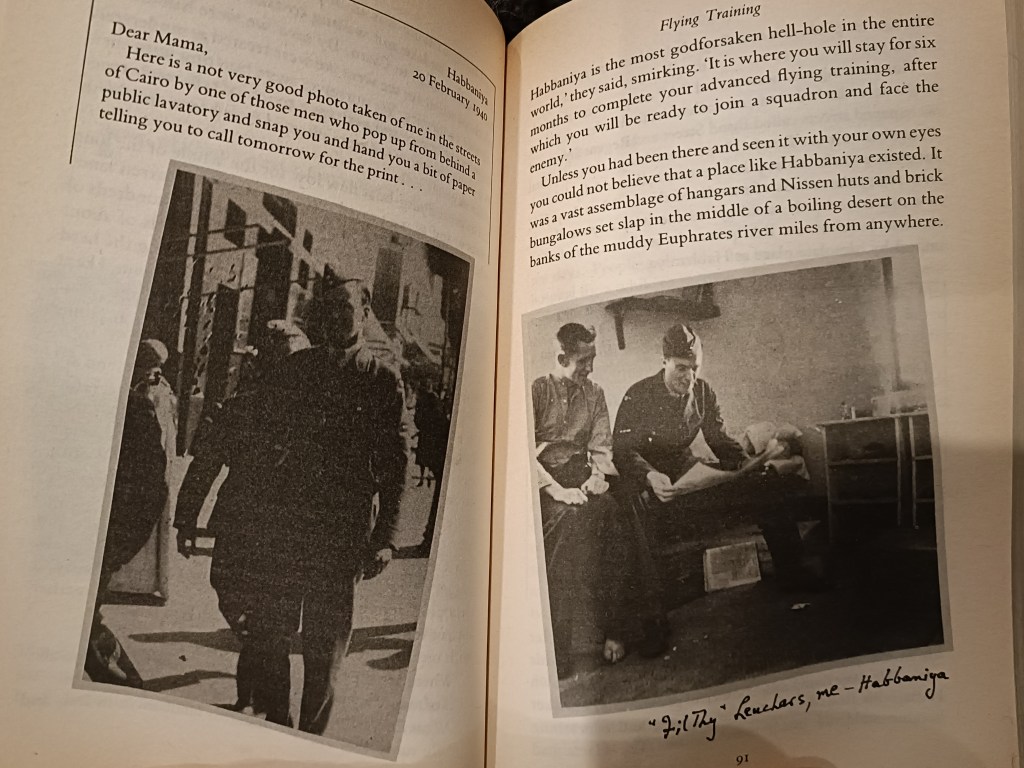
    Going Solo is told as a series of vignettes rather than a continuous narrative and covers the author’s time working with the Shell company in East Africa and his service as a fighter pilot with the RAF during the Second World War.

    Sprinkled throughout are black and white photos, mostly taken by the author, and excerpts from letters back home to his mother, as well as maps, telegrams and documents like his flying log. This mix serves to round out the reading experience into a wonderful voyage to the past – like walking through a museum with the best tour guide ever.

    In Africa, he tells of narrow escapes from deadly snakes with the help of an eccentric Scottish snake-whisperer. There’s the time a lion grabs the cook’s wife in its jaws and starts trotting off with her (since, miraculously, the cook’s wife escaped unharmed, I feel the quote at the top can still be used in good taste) and a story of Dahl’s native ‘house boy’ and friend who, upon hearing that his employer is soon to be at war with the Germans, takes matters into his own hands, in the style of his native warrior tribe.

    With his signature talent for characterisation, Dahl describes the ‘completely dotty’ chaps and chapesses he spent his time with in and en route to Africa. While we might now look with much scepticism on the colonial project the author was part of, it made for a fascinating read – an insight into both the native and the colonial way of life.

    The author’s own colonial self-awareness was beyond what I expected for his time. When his ‘boy’ and good friend, Mdisho, goes rogue based on a cultural misunderstanding the size of Everest, he writes:

    “I refused to blame him for what he had done. He was a wild Mwanumwezi tribesman who had been moulded by us Europeans into the shape of a domestic servant, and now he had broken the mould.”

    It’s great fun to read the stories in his native British wartime language. It’s not quite ‘bally ho, what what!’ but a believable version of that voice for which my main reference point is parody. It was a delight to feel like I was stepping into a past I’ve had little contact with, even through literature or film. While I have read many books from the 19th century, the early-mid 20th seems to be a bit of a blank spot in my reading vocabulary.

    The author’s wartime stories are thrilling and harrowing in equal measures. The whole time, I couldn’t help but marvel and thank the fates that he made it back alive to not only tell this tale, but all the others that have made him a staple of children’s bookshelves.

    Arriving in Greece fresh from a near-death experience and long recovery in hospital, he finds himself totally unprepared and untrained, flying among a squadron of fifteen fighter pilots and four bombers (a number that diminishes literally by the day) tasked with taking on a thousand German planes.

    The young author takes it all in his stride, watching his fellow pilots fall out of the sky, shooting down German planes and knowing he is unlikely to make it through the week. ‘We weren’t afraid of anything’, he says of the group of young RAF pilots. Reading it ninety-odd years on, rugged up in my blanket, a world where this kind of daily brush with mortality was accepted without the bat of an eyelid was harder to imagine than a whiz popping giant.

    In the context of recent controversies over this author – the attempted cleansing of his children’s books (removing words like ‘fat’ and ‘ugly’) and the general whiff of unsavouriness that seems to have swirled up around him (Philip Pullman, author of The Rose Field, has gone so far as to suggest that Dahl should be left to go out of print) – I was subconsciously looking for hints of this nasty character as I read. I found nothing I couldn’t like about this man.

    Of course, in a memoir, one is the author of one’s own self-image, but it’s remarkable how nasty people can still give themselves away even with all the scrubbing tools at their disposal. The memoir was written more than forty years after the events, when Dahl was in his sixties. Still, in all his attitudes he appears warm, humble and open-minded.

    The Roald Dahl of later years earned a bit of a reputation as an anti-Semite, and some quotes attributed to him certainly make that charge hard to defend.

    Interestingly, the last story in Going Solo tells of meeting a Jewish refugee at a desolate aircraft base in Palestine, where he is hiding out with a school of Jewish orphans. The man speaks to him, somewhat cryptically, of his intention to set up a Jewish homeland. The author comments that as they spoke, he had no idea that the biggest massacre in human history was currently taking place in Germany.

    It’s not impossible that some of the author’s less agreeable views were edited, or self-edited, out of this book, but all I can say is the Roald Dahl of both his memoirs is an utterly charming man. On whether this gives a complete account of his true character, I prefer to remain both ignorant and ambivalent.

    I devoured this book. I knocked it over in a week, which is as fast as I can remember finishing a book in basically forever. It’s an easy and fun read, but fascinating and enlightening. For the first time in a while, I was not just enjoying reading time when I could snatch it but finding excuses to go to bed early and sit with it late into the night to read just a bit more. It was a treat worthy of Willy Wonka’s Chocolate Factory, and, like all the best treats, it left me wanting more.

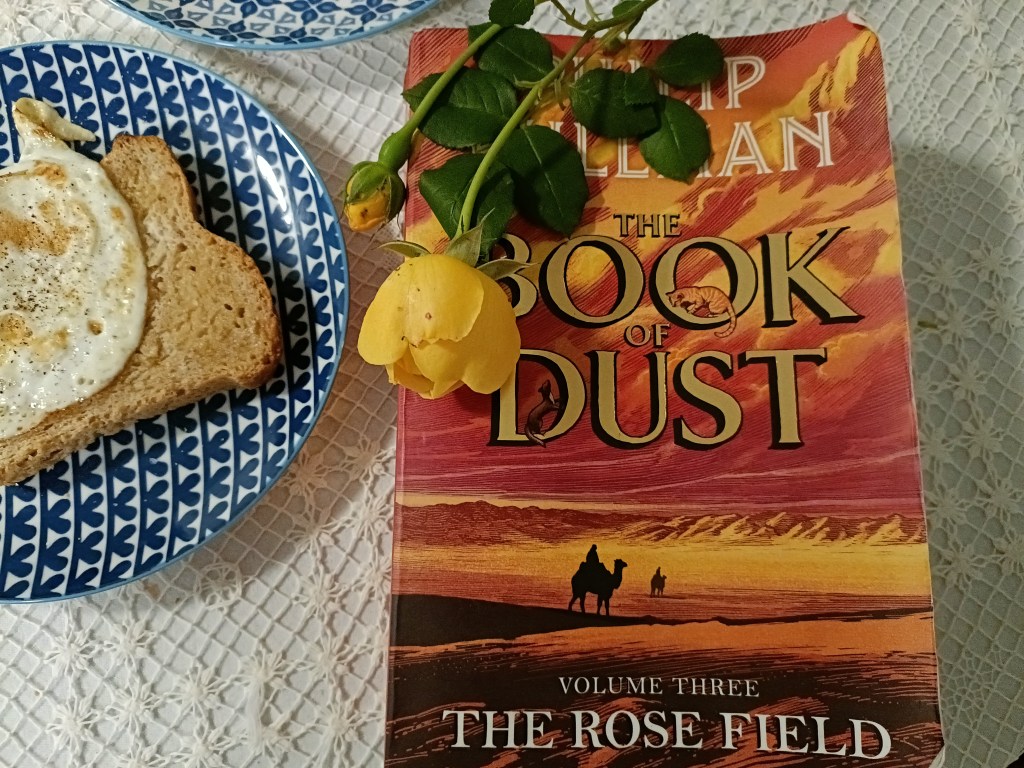
  • The Rose Field – Philip Pullman

    The Rose Field – Philip Pullman

    a book symbol, denoting a physical copy read

    The Book of Dust Book 3

    “Almost as If everything beautiful was in another world, and there was a doorway, and if I could only find it…”

    The Rose Field is the long-awaited conclusion to Philip Pullman’s Book of Dust trilogy, which follows on from His Dark Materials, the original epic fantasy/science-fiction trilogy that earned a place in hearts and bookshelves around the world over two decades ago.

    It’s impossible for me to discuss The Rose Field without situating it among the other five books in the series. Some (much) contrast and comparison and contextualisation is required – please bear with me.

    His Dark Materials follows eleven-year-old Lyra, who lives in an alternate universe much, but not quite, like our own. On gypsy river boats, the broomsticks of witches, the back of an armoured bear and the basket of a Texan aeronaut’s balloon, Lyra ventures all the way to the North Pole and into another world – where she meets Will, a fellow world-traveller from our own universe.

    As they travel between worlds together, they flee soul-sucking Spectres and befriend quadrupedal animals on wheels. They lead a march of the shadowy dead out from a purgatorial underworld and team up with fallen angels to do battle with the ultimate Authority. Flitting amongst all of this are Lyra’s own brilliant and terrible parents, partially estranged from her and each other, each pursuing their own academic obsession in parallel or perpendicular to Lyra’s endeavours.

    His Dark Materials is an exploration on the nature of consciousness, the perils of religion and the possibilities of the many-worlds theory of quantum mechanics. There is a lot going on, to the point where I imagine most editors would throw up their hands and cry, ‘Leave the kitchen sink behind!’

    Despite this, or because of it, I would go so far as to call it a perfect trilogy. Notoriously difficult as it is to satisfactorily end a fantasy series, this one has an ending of such bittersweet beauty as hasn’t been seen since Frodo sailed off to the Undying Lands on an elven ship. The level of brilliance required from Pullman to perfectly achieve such an ambitious endeavour is nothing short staggering.

    If you haven’t read this trilogy (Northern Lights, The Subtle Knife and The Amber Spyglass), go and do so immediately. I promise it will enrich your life. If it doesn’t, the Spectres must have got to you already. You’ll likely find it in the children’s section, but in my many re-readings since I first devoured it in my early teenage years, I’ve found new meaning and points of reflection every time. It’s one of those books that offers a page-turning magical adventure for young readers and philosophical contemplation (plus the page-turning magic) for older ones.

    After all of this preamble, we finally get to The Book of Dust, the second trilogy, of which The Rose Field is book three (I hope you’re keeping up). Seventeen years after the final installment of His Dark Materials, we got La Belle Sauvage – a prequel featuring Lyra as a baby, in which we see the origins of political and religious machinations in her world that drive much of the original trilogy.

    The second installment in The Book of Dust (trilogy #2) is The Secret Commonwealth, which jumps forward twenty years to Lyra as a young woman, having returned to her own world to a relatively normal and uneventful life. Ten years on from The Amber Spyglass, we meet her as a shadow of her former fiery self: bored, cynical and a bit depressed.

    The spark of magic was dimmed not just in her, but also seemingly in her whole world. So brimming with wonder and surprise in Northern Lights and still in La Belle Sauvage, the world of The Secret Commonwealth and The Rose Field is much more subdued, much closer to the humdrum nature of our own world. The armoured bears and aeronauts have retreated, giving way to electric vehicles and corporate takeovers.

    In The Secret Commonwealth, Lyra’s daemon (spirit-animal), Pantalaimon, leaves her and embarks on a solo journey to Central Asia in search of what he claims is Lyra’s lost imagination, and of course she must go after him. Malcolm, the young protagonist of La Belle Sauvage, who delivered Lyra to safety in a great flood, plays a starring role here, despite having never appeared in the original books. He sets off after Lyra to bring her safe home once again.

    Caught up in it all is another young man seeking vengeance, determined to hunt Lyra down, and it’s all set against a dangerous political backdrop in which Lyra and her friends are operating as dissidents in a world of religious authoritarianism.

    While La Belle Sauvage didn’t live up to the brilliance of the original trilogy, it felt like another excellent adventure story in the same universe, though it leaned rather than built upon the themes of HDM. The Secret Commonwealth was a little more sedate, perhaps overly philosophical, a little plodding. I found it flawed but enjoyable, with a strong-enough story, and all the strengths of the original world, characters and ideas. The Secret Commonwealth ends with Lyra alone in the desert of Karamakan, searching for Pantalaimon and the imagination she’s lost.

    I was so looking forward to the final chapter in the story that when the coronavirus pandemic arrived, I clamoured for the author, who was by then in his mid-seventies, to be locked up in quarantine under armed guard with only pen and paper and daily food rations while he finished the last book.

    Finally, in late 2025, The Rose Field was published.

    This final chapter picks up exactly where its predecessor left off and sees Lyra travelling into Syria and picking up a charming rogueish travel guide before meeting up with Malcolm in Aleppo. Pantalaimon, Lyra’s daemon, and Malcolm find themselves captured by gold-obsessed gryphons in a mountain tower and form an alliance with the witches to take on the Magisterium, a religious political body which has set about to destroy the entrances to other worlds.

    How all these plot lines connect is something of a mystery. Each time a new thread is started, there’s a sense of intrigue and excitement around how it will tie into the existing narrative and world. Sadly, most of these threads, some started in The Secret Commonwealth and some picked up fresh in The Rose Field, seem to get forgotten about and left on the cutting room floor.

    I’m doing my best here to avoid a full-blown rant about every plot line in The Rose Field that never got resolved. There is another side plot involving the resistance movement Lyra and Malcolm are part of, but this gets dropped about three quarters through and never seems to achieve anything.

    In His Dark Materials, Pullman shows himself to be capable of plot-mastery, but he fails to live up to it in the last two books of this second trilogy, and in The Rose Field most of all. You can almost feel, at times, the author’s dot points: ‘this must happen so that this can happen next and so that I can make this point about that.’

    Lyra’s ‘lost imagination’ is a core theme in The Secret Commonwealth and The Rose Field which never quite worked for me as a propulsive plot device. The journey through Central Asia is evocative but always somehow feels driven more by narrative necessity than by causal events and motivations that make total sense within the world of the book.

    If Philip Pullman has a weakness as an author to counter his many strengths, it’s a tendency to be a little didactic. He reigns it in to a surprising extent in his novels, considering how controversial he can be in interviews, but the author’s strongly held opinions do sometimes peek through the page. In these last two books it feels like his editorial leash has been slackened. The books get longer, but not better. In fact, by the end of The Rose Field it felt like Pullman had broken the leash altogether and run off solo to howl at the moon. He claims he revisited Lyra’s story after all these years because it hadn’t really finished. But it felt in this final book like he wrested the story away from his protagonist and turned it into a vehicle for a personal political diatribe.

    The characters we came to love in His Dark Materials are mostly forgotten in this second chapter, replaced by (ironically) much more forgettable supporting characters, who never seem to have much to do. The exception is Mr Ionides, Lyra’s roguish travel guide, who is totally charming but whose role in the story ultimately feels tangential.

    Lyra as a young woman lacks a lot of the spirit and sense of fun she had as a girl. This is in part what drives the story in these last two books – she must reclaim her lost sense of self – but it does mean that as a character she’s a little less charming company than she was in the first three books. This same goes for Malcolm the man. While there is nothing especially wrong with him, herein may lie the problem. He’s solid, steadfast, learned, capable and infinitely sensible. In other words, he’s a bit dull.

    Taken at face value, the majority of The Rose Field is an enjoyable-enough story. Pullman’s scene-by-scene writing is mostly as excellent as ever, though a little rough around the edges in parts. The pacing is particularly poor, some of the dialogue overly expository and at times he seems to even lose control of the omniscient point of view.

    Most of the way through, I felt The Rose Field was still a few drafts off a great book. Once I read the final page, I was in disbelief that the author would spend so much time and creative effort only to give the least satisfying possible resolution to a story he’s been immersed in for two decades.

    As a book, the sum of its parts is good enough, and even holds much promise. The whole is a giant mess, especially when considered as half of a 1200-odd page story, spread over two volumes (considering this as a continuation of The Secret Commonwealth) which never goes anywhere.

    If the narrative journey of Northern Lights could be likened to a mad dash on a snow sled culminating in a leap over an icy gorge, that of The Rose Field feels more like an aimless wander through a rose garden, during which occasionally you start sprinting towards something, only to run into a thicket of brambles and thorns which require a lengthy extrication process. The action moves forward at pace, then grinds to a halt as important plot points are revealed through long and plodding conversations. The next thing that happens will feel more randomly chosen than preordained. By the end, I felt that Pullman had fallen into a bramble so thick he couldn’t cut his way out. He clearly had many ideas but didn’t seem to be able to figure out how to tie them all together and it feels like, despite the long writing process, this book was rushed to publication way before its time.

    The conclusion we waited twenty years for could not be further from the exquisite ending of His Dark Materials that broke so many hearts.

    The ending of The Rose Field blows open plot holes the size of the Grand Canyon, drops characters by the wayside, cuts off every narrative thread and basically makes everything that came before it seem entirely pointless. It could be said it leaves plot holes large enough for a million soul-sucking Spectres to float through. Worst of all, it undermines and contradicts much of what happened in the original trilogy – especially the bittersweet conclusion – and makes us wonder what it was all for.

    I heard Pullman say in an interview that he rewrote the ending about eight times as his editor kept telling him it was no good, and he claimed the ending was much better for all the rewrites. What those alternative endings were, we may never know, but it’s hard to imagine anything worse than the one we got, which I can only imagine was a result of compromised creative visions, fatigue and compressed publication schedules.

    Of course, in my rage and disbelief once turning the final page, I immediately turned to the wisdom of Reddit and found some small solace in the outpouring of frustration from other readers over the plot holes, side quests, discontinuities and disservices to the original story and felt similarly let down by this (lack of a) conclusion. It’s rare that an ending can be so dissatisfying as to almost make you want to erase the whole book (or books) but The Rose Field comes pretty close.

    Avid readers of His Dark Materials waited two decades for this final installment to give our beloved Lyra’s story a continuation worthy of its beginning and the resolution she deserved. It didn’t have to be a happy ending, but it should have been a story worth telling.

    The quote at the top of this post hit hard for me: the character is describing unearthly music heard in another world through a portal he could never find. I spent much of my young life believing that everything beautiful was in another world. I went through doorway after doorway in search of it. It took a long process of growing up to learn that beauty was in front of me all along – including, but not in any way limited to, wondrous creations of the imagination.

    But Philip Pullman created one of the most beautiful otherworlds I ever had the fortune to escape to. To pick up the story after all these years only to finish it in such a way as to make the whole six-book-long endeavour seem pointless felt like setting a bomb to this wondrous creation that meant so much to so many. This is, of course, a childish attachment to what is ultimately just a set of books. But I’m sure the author would agree that putting away childish things entirely is no good way to grow up.

    Ultimately, I salute Philip Pullman on creating not just one but three perfect books. His Dark Materials has given me so much joy, so much contemplation, over the years. I even read some lines from The Amber Spyglass at my wedding. I wish him only the very best in his well-earned retirement from creative life. (Please, Philip, no more.)

  • The Will of the Many – James Islington

    The Will of the Many – James Islington

    headphones, denoting audiobook

    Hierarchy Book 1

    Audiobook narrated by Euan Morton

    ‘“We are what they make us, Diago.

    Silence is a statement, inaction picks a side. And when those lead to personal benefit, they are complicity.”

    Hail Islington, master storyteller, recreator of ancient worlds, weaver of woeful tales!

    In my youth, I sought out gripping fantasy adventure novels and devoured them with a fervour that was not altogether nourishing. It could be said that the hunger has never died, but over the years I have tempered it somewhat, balanced the emotional investment in make-believe worlds with the more mundane joys and frustrations of the earthly realm.

    But they do say once an addict, always an addict, and there’s still nothing quite like the pleasure of sinking deep into a story that completely sucks you out of reality and makes you wonder if it would really be so impossible to perform your job with optimal efficiency while staring blankly at the computer screen completely transfixed by an audiobook.

    The Will of the Many is the first book in Melbourne author James Islington’s Hierarchy trilogy and possibly my first unqualified book recommendation of the year.

    Vis is the orphaned prince of a royal family slaughtered in a military takeover, trying to hold onto both his life and his values in a world controlled by his family’s killers. The Hierarchy is a civilisation built on the ceding of magical power (Will) up through an eight-tiered pyramidal structure so that the members of each tier are enriched by the power fed from below – like a pyramid scheme where instead of being bled for money, those on the bottom rungs are leached of their physical and mental power.

    The world is loosely based on ancient Rome – everyone gets about in togas and greets each other with ‘hail’ and watches fighting matches in a giant circular auditorium – with influences from other ancient civilisations, including cursed pyramids with strangely preserved bodies adorning the walls. It’s an inspired premise – Islington has blended elements of these inherently wondrous ancient civilisations and imbued them with just a little bit more magic.

    If the premise of orphaned royalty with a chip on his shoulder sounds familiar, it’s because it’s a trope as old as Hamlet – and also oddly similar to the setup for Dragonflight, even up to the point of Vis being ‘rescued’ from his dire existence in an orphanage when he’s adopted by the wealthy and powerful Quintus Telimus, a high-ranking Hierarchy official. But this is most definitely where any similarities with that other dreadful book end.

    Vis’s adoption has less to do with his new father’s desire for a son and heir than it has to do with the secret mission the Quintus has in mind and his need for a smart, capable, manipulable young person with no better options to carry it out. Vis is catapulted from rags to riches, from the orphanage to magic school where he must excel at the Academy in order to fulfil his adopted father’s plan and save himself from dear Papa’s threat to send him to the Sappers – to be shackled and robbed of his Will, his life force, to feed the machine of the Hierarchy.

    I’m a firm believer that tropes in genre fiction are to be embraced rather than feared. The Will of the Many is not short on tropes, and nor, I will argue, should it be. It is, after all, hard for our young protagonists to have great adventures if they have doting parents calling them home for supper each night, and hard to summon the courage and commitment to risk skin and sanity rebelling against an oppressive power without a solid revenge plot to fuel the fire. Of course, though, nothing is quite what it initially seems in Vis’s world, which is where the fun begins.

    When I say fun, it’s not to imply that our hero is having a great time. In fact, one of the things I most admire about Islington as a storyteller is that he’s not afraid to put his characters through the wringer – squeeze them, mince them up, spit them out and piece them back together again, only to find another slicer-dicer around the next corner. It’s harder than you’d think. Over the course of writing a novel you become so attached to your protagonist, it’s hard to bring yourself to cause any great harm to come to him – which is of course the exact source of the story’s emotional core. And poor Vis is certainly no stranger to the mincer. He initially finds himself embroiled in a mystery surrounding Telimus’s lost brother, and by the end finds that things are in fact much more complicated than anyone could have imagined.

    There is so much to commend this book. The world is fresh and original, the characters are well drawn and through all the misery of the situations they have to sort through, the friendships Vis forms are a warm, beating heart through which the narrative blood pumps. Mystery unravels at just the right pace and in unexpected ways. The troubles of the Hierarchy feel relevant enough to be thought-provoking and relatable, while not being so closely modelled off reality as to intrude on the story-world with heavy-handed metaphors.

    There are strong echoes of Patrick Rothfuss, whom Islington cites as a major influence and even an early mentor. Perhaps not entirely coincidentally, this was my favourite fantasy read since The Name of the Wind, which I discovered a few years ago. Both books have immediately gone into my ‘to be re-consumed’ pile. The boy-prodigies, and the cast of lovable friends they amass at their respective magic academies, bear many resemblances, yet the styles are very different. Where Rothfuss is renowned for his poetic prose, Islington’s style is more direct. He is a plot-forward writer, yet his prose, dialogue and characterisation are all strong and assured. Having now finished the sequel, The Strength of the Few, with the third instalment likely a few years off, I can only hope and pray that Islington doesn’t take too many leaves out of the Rothfuss book.

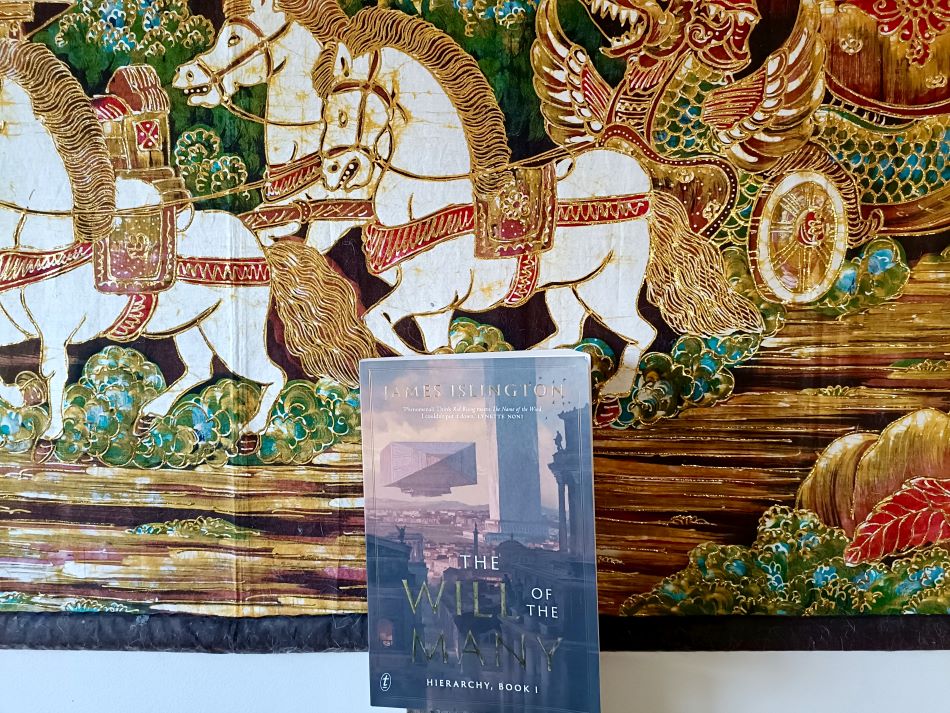
    The audiobook, narrated by Euan Morton, is well performed with a hard-to-place accent that made me wonder if it was an Australian narrator performing a miscellaneous British accent or a British narrator performing a miscellaneous almost-Australian accent (apparently the latter). While the audiobook was a great way to immerse myself in this story and rush through it apace, I did end up feeling that there was enough meat in this book to warrant reading in its physical form, which allows for slowing down, taking in details and ensuring no small piece of information is missed. When I inevitably revisit this book, it will most likely be in hard copy format. If you’re wondering why the cover photo shows a hard copy book, it’s because I rushed to buy a copy as a birthday gift ‘for my husband.’

    I sometimes worry that I’ve destroyed my reading-for-pleasure ability by over-developing my critical reading faculty, so I couldn’t be more pleased to be struggling to find fault with this book.

    Yes, our hero boy-prodigy is uncommonly heroic: some readers take issue with his exceptional academic, athletic and problem-solving abilities, combined with his unerringly noble and courageous deeds. This is probably the biggest nod to The Name of the Wind , but in both books I’m inclined to forgive this slightly tongue-in-cheek protagonistic infallibility, self-reported (both stories are told in first-person) with perhaps an extra seasoning of young male egotism. It’s just a little more disbelief to suspend, and, with neither trilogy yet complete, pride may be a good setup for an interesting fall.

    The book is long, which is often a sign of fat that should have been trimmed. I have become much more suspicious over the years of the ‘longer the better’ mantra I once held, but in this case I chewed every chapter with relish. So often lately, even with books I’m largely enjoying, I find myself racing towards the end as they start to sag or stale and wear out their welcome.

    The Will of the Many was a beautiful nostalgic trip back to simpler times when my biggest existential worry was that at some point the book would be over and I’d have to close the covers and return to real life, feeling desolate.

  • A Court of Thorns and Roses – Sarah J Maas

    A Court of Thorns and Roses – Sarah J Maas

    headphones, denoting audiobook

    Audiobook narrated by Jennifer Ikeda

    ‘Do you have a plan?’

    ‘No.’

    There are good books and bad books and in-between books. There are so-good-you-want-to-make-everyone-read-it books, and there are so-bad-you-want-to-warn-everyone-to-avoid-it books. There good books that you plough through and excellent books that you struggle to find the energy for, books that are unreadably bad and books that are plain dull. And then there is the special category of books that are so bad they’re almost good. A Court of Thorns and Roses is not the worst book I’ve ever read, but it might be the best-worst.

    This title, the first in the ‘ACOTAR’ series, as it’s known within the cult, had been a stalwart in my ‘maybe to read’ pile for a couple of years. I was pretty sure it was rubbish, but it had been recommended by at least one person with some crossover in book-taste and I’ve avoided books before out of snobbery that I’ve ended up enjoying. So when I saw it on the lineup for the excellent ‘The Book Club’ podcast – and mistook a jocular reference to it as one presenter’s ‘favourite book of all time’ as a sincere endorsement – I decided it was worth taking the plunge for what was sure to be an easy listen.

    Jennifer Ikeda, despite her unfortunate American accent, does a decent job of the narration, probably working the source material about as well as anyone could.

    Sarah J Maas wrote her first book, Throne of Glass, at age 16 and has amassed a serious cult following with her ‘romantasy’ series, blending high fantasy with adult romance. The first three-quarters of this book is basically Beauty and the Beast reimagined as a gothic bodice-ripper. Throw in some Fae folklore and a few more mythical creatures, Disney tropes and vaguely sketched Fae court politics (and some slightly more explicit bodice-ripping), and you have yourself a global phenomenon and multi-million copy bestseller. The last quarter or so of this indefensibly long slog feels more like a classic fairy tale with twenty-first century teenagers. But there is actually a fair bit of plot here, so I will try to briefly summarise.

    Nineteen-year-old Feyre lives with her two older sisters and crippled father in a small cabin on the edge of the woods. Armed with bow and arrow, she hunts to keep her family fed. When one day she kills a giant wolf who turns out to have been a faery in beast-form, payment is demanded and she is taken to live a life of imprisonment in the Fae realm of Prythian (modelled on ancient Britain).

    What follows is mostly a parade of confusing mythical creatures who inevitably come after Feyre after she repeatedly ignores instructions for own safety – which of course requires her to be rescued by her captor, the High Lord Tamlin, a shape-shifting man-beast cursed to live under a mask, even in human form. Between them slow-boils a hot-blooded love affair, complete with claws, growling and many uses of the words ‘feral’ and ‘predatory’. But in time, Feyre finds that nothing is what it had seemed in Prythian. To rescue her beloved, she goes boldly into the court of evil Queen Amarantha with no plan whatsoever, and finds the fate of the world balanced in her highly incapable hands.

    Like Dragonflight, A Court of Thorns and Roses is quite good as a plot summary. There’s actually a lot going on, but unfortunately it mostly happens off the page. Most of the consequential events and background are narrated through expositional dialogue – and then further explained, just in case you missed it. It reminded me of the new breed of Netflix content produced under the explicit assumption that viewers will be on their phones throughout and only half paying attention. ACOTAR was published in 2015, but had it come out this year I would have seriously questioned if it was written by AI – especially in the light of revelations that many romance writers are already embracing this new technology to spit out over 200 books a year.

    The writing is incredibly childlike, which is an odd juxtaposition with the ‘adult’ content (although it should be said the bodice-ripping mercifully took up much less real estate than I’d expected). There is no subtlety to be found here; no complexity, no nuance, no subtext. Everyone will tell you exactly what they think, and then go to great lengths to explain what they meant by it. The characters are flimsy and the worldbuilding feels thin. The narrative is riddled with inconsistencies, crater-sized plot holes, baffling decision-making and nonsensical sequences of cause and effect. Though the emotional stakes should be high, I could never take anything seriously enough to feel invested in it. I found myself bemused by the supposedly terrifying monsters and the sheer stupidity of basically everyone and everything.

    “He could have had me right there on top of that table. I wanted his broad hands running over my bare skin. Wanted his teeth scraping against my neck. Wanted his mouth all over me.“

    ‘I’m trying to eat!’ Lucien said as I blinked, the air whooshing out of me.”

    Which leads to my designation of ACOTAR as the best-worst book.

    Despite the atrocious dialogue, the nonsensical plot, the inconsistent world and idiotic characters, there was somehow enough here to have some fun with. It gave me plenty of (mostly unintended) laughs, and I’ve come to believe that a terrible book beats one that is merely uninteresting. If this book has a saving grace, it’s in the pacing, which keeps the story moving along swiftly enough that you always at least feel like you’re getting through it (albeit making use of the speed-up setting in the audiobook and despairing at the number of chapters still to go.)

    I was determined to finish it out of curiosity (and because I’d paid for it) and so that I could follow along with the ‘Book Club’ episode. As soon as I finished, I tuned in to the podcast, eager to hear the hosts mock and tear it to shreds. Imagine my horror and disappointment when they instead tried to be very fair, assessed it for the light fluff that it is, and both rated it 6/10 – one host raising eyebrows by rating it higher than the Steinbeck classic East of Eden.

    Every now and then Sarah J Maas surprises with a sentence, a character arc or a plot twist that makes you think she could probably write something decent if she tried. It’s obvious this book was written quickly, but when I learned Maas had written it in five weeks, I was actually forced into grudging admiration for the output, given just how quickly she slapped it together.

    Many of the most avid ACOTAR readers seem to be people who are just getting into (or back into) reading for pleasure, and if Maas’s work not only brings joy and excitement but also acts as a gateway into a fulfilling reading life, that can only be a good thing. I couldn’t help making comparisons to Australian author Juliet Marillier, whose book Daughter of the Forest remains an all-time favourite of mine, also heavily inspired by Celtic mythology. Although Marillier’s fantasy romance books are certainly formulaic, they are beautifully written with real emotional stakes and well-developed characters. I hope some ACOTAR fans will find their way to her.

    There has long been the kind of commercially successful genre book that worships at the altar of substance and throws style out the stained glass window. There are highly prolific authors like James Patterson essentially running book factories with teams of junior co-authors. I’m not going to argue with the millions of people around the world who have showered adoration on this book and the ACOTAR series.

    Sarah J Maas is clearly onto a winning formula and good luck to her – but having dipped my toe into the world of the Fae, I was left with no desire to become a permanent resident of Prythian and offer up my brain in sacrificial worship to Queen SJM at the ritual bonfire.

  • Dragonflight – Anne McCaffrey

    Dragonflight – Anne McCaffrey

    Audiobook narrated by Sophie Aldred

    Drummer beat and piper blow

    Harper strike and soldier go

    Free the flame and sear the grasses

    Till the dawning red star passes

    Floundering in my endless quest to find great new fantasy / sci-fi / dystopian reads, I recently decided to revisit some fantasy books I had enjoyed in my teenage years and see how they held up to rereading.

    This one did not hold up. I was left feeling somewhat ashamed of my teenage-self, who happily chowed through quite a number of books in this series. I struggle to match up the teenage-self of my memory—who I’m sure was an erudite reader of the classics and a deep thinker with highly sophisticated taste—with the one who enjoyed this drivel enough to return to the library for sequel after sequel.

    First published in 1968, Dragonflight was a pioneer of the genre and has clearly served as inspiration for many other books and series since—including possibly the entire ‘romantasy’ genre. It won McCaffrey both a Nebula and a Hugo award, making her the first woman to win either of those prizes. The story is of a young woman, Lessa, who escapes a life of servitude to become a dragon queen tasked with saving her planet from destruction.

    All of this is a strange precursor to the following statement, which is that this is possibly the most sexist novel I’ve ever read (with the possible exception of Cormac McCarthy’s Outer Dark.)

    On the distant planet of Pern, far into the future, humans have set up an agrarian colony which has functioned for over 2000 years with just one major problem. The irregular orbit of a neighbouring planet periodically brings it close enough to cause atmospheric changes that result in ‘Thread’ (think acid rain) to fall from the sky, turning fertile soil to wasteland. Cue the dragonriders, who combat the falling Thread with fire-breathing dragons, genetically engineered from an endemic reptile species.

    Lessa is the sole survivor of a noble family killed by a usurper. She survives by disguising herself as a kitchen maid serving her family’s murderers—until one day she is rescued / captured by the dragonrider F’lar, who sees in her a chance to regenerate his declining weyr (dragon commune) in preparation for the next Threadfall, a threat the people of Pern have all but forgotten.

    So far so good. As a plot summary, Dragonflight is excellent. As a book, not so much. It’s hard to believe that such a great premise could be so poorly executed, especially considering that McCaffrey is not an untalented writer.

    Even as I get this all down, my appreciation for the world, the ideas and the premise of the story is almost making me feel like reading it again. It’s the same devil’s voice that keeps telling me I want to watch the Harry Potter movies one more time, only to find that they haven’t got any better in the last decade. It’s that part of me that can’t relinquish the idea of how good something could have been, despite reality having resoundingly proven it otherwise. McCaffrey’s worldbuilding is excellent and her prose is solid and assured, but these can’t redeem the faults in other essential story elements.

    After her forceful translocation, Lessa imprints with the gold dragon queen, forming a telepathic bond, and becomes Weyrwoman of Benden Weyr. It sounds like our girl has risen to great heights, except that it turns out the duties of the esteemed Weyrwoman turn out to mostly comprise cleaning, housekeeping and stocking the pantry. And she’d better do it right, or Weyrleader F’lar will shake her. That’s right, physically shake her. He does this a lot.

    “Oh, F’lar will be so angry with me. He will shake me and shake me. He always shakes me when I disobey him.”

    The story alternates between Lessa’s and F’lar’s point of view, which is one of its key weaknesses as F’lar is about the most unlikeable character ever put to the page. Which is unfortunate for Lessa, because as the Weyrleader bonded to the bronze dragon, F’lar is bonded to her, too.

    The telepathic bond shared between dragons and their riders extends to a seasonal dragon mating flight, during which the dragons’ bonded human pairs get tangled up in the passion. This means the dragonriders don’t choose their romantic or sexual partners, which results in some loose boundaries around consent. This is the way of things at the weyr and generally accepted, but Lessa, an outsider, is inadequately warned or prepared. Worse, F’lar continues to ‘share her bed’ after this event (sans synchronous dragon sex), despite Lessa’s total lack of enthusiasm. While the lack of consent is acknowledged, it’s not judged as particularly problematic, either by F’lar or by Lessa, which makes the story an incredible legitimisation of rape culture.

    He had been a considerate and gentle bedmate ever since, but, unless Ramoth and Mnementh were involved, he might as well call it rape. Yet he knew someday, somehow, he would coax her into responding wholeheartedly to his lovemaking. He had a certain pride in his skill, and he was in a position to persevere.

    Passages like the above are hard to read, and it’s hard to spend so much time inside the head of someone so deeply unlikeable.

    All those years ago I remember being disturbed by an even-more egregious scene in the second Dragonriders book where the love interest of a young, scared female character sexually assaults her to ‘prepare’ her for the dragon-mating experience with another rider—a crime presented and accepted as an act of necessary cruelty with her best interests in mind. I had forgotten how much this scene exemplified the norms within the Pern novels.

    Though she hardly started the trend. McCaffrey feels like an unhelpful instalment in the long line of female writers propagating damaging norms around sexualised violence and coercive control, sold as titillation (looking at you, Fifty Shades of Gray).

    It would have been so nice to see the controlling, arrogant F’lar get his comeuppance in this story, or perhaps a redemptive character arc. But no. F’lar is possessed of a unique foresight and strategic skill. All his unpopular theories turn out to be true. He thinks he can continually rape Lessa until she starts to like it, and guess what…

    All this makes me think of other times I’ve had the discussion: ‘is it a sexist book, or just a book depicting a sexist world?’ Many people point to the fact that the culture around consent and gender norms was very different in the sixties when this book was written, but that doesn’t seem like an adequate explanation.

    No one has ever accused Jane Austen or the Brontes of degrading women in their work, though they wrote in a time far behind 1960s America in terms of women’s standing in society. The female characters in these books were fully realised humans who chafed against their constraints and grew as a result, shaped in partnership or in opposition to the world around them.

    I don’t think it’s particularly hard to distinguish a sexist book from a sexist world. In the former, female characters are poorly developed, often thrown in only as love interests for the male characters, and limited in ways that the narrative does not recognise or address. In the latter, female characters are given equal or greater depth to their male counterparts. Their needs and desires are equally recognised by the narrative, if not by those around them, and form the shape of their character arc.

    And honestly it’s hard to judge Dragonflight by this measure, as all the characters are so flat and one-dimensional that it’s hard to know what any of their needs and wants are. What can be determined is that the book legitimises the treatment of women in the reactions of the female characters, or the lack thereof.

    Where Lessa should be a feminist icon, riding out on her gold dragon to save the planet, she feels more like a mute wallflower, living in fear of F’lar’s temper and the inevitable shaking that ensues whenever he catches her ‘disobeying’ him. Instead of rising up against this or finding ways to grow in opposition to his treatment, Lessa never seems to question F’lar’s right to manhandle and rape her. All she needs is a bit of time for his arrogant charms to work their wiles.

    Riding on plot momentum and curiosity alone, I pushed through to the end of Dragonflight. But if I seem hazy on how the story ends or have got some details incorrect, it’s because I didn’t care enough to rewind if I fell asleep halfway through a chapter or got distracted by a bird and missed a chunk of storyline. I should mention that narrator Sophie Aldred does a great job and her lilting tones probably played a significant role in getting me through the book.

    From an exciting story premise and some strong worldbuilding, McCaffrey is able to extract only shadows of characters, who float through the world lazily pushing the plot along. The decision to tell half the story from F’lar’s perspective steals the spotlight from the female protagonist, who is under-developed and, while much more sympathetic, also just not that much fun. The character interactions are shallow and at times baffling. The readerly jaw, dropped initially by the rampant misogyny, ends up stretched in a giant and ongoing yawn.

    All I can say in defence of my younger self—and the judges who awarded this book the most coveted awards in the science-fiction and fantasy genres—is that it may have been, for both of us, a first encounter with such an elaborately conceived sci-fi world. I was perhaps so bedazzled by the idea of what the book could have been that I forgot to tell the devil on my shoulder to shut the hell up and give me something decent to read.

  • The Places In Between – Rory Stewart

    The Places In Between – Rory Stewart

    Audiobook narrated by the author

    ‘In many houses, the only piece of modern technology was a Kalashnikov, and the only global brand was Islam.‘

    Every now and then you come across a book that makes you want to run down the streets, waving it in the face of everyone you pass.

    It’s not that this is the most incredible book ever written in terms of its craft or the sublime beauty of its prose, although it’s certainly impressive. But I’m a sucker for a great story, potentially especially so for a great true story. Rory Stewart is a former British diplomat and politician and now co-host of The Rest Is Politics podcast. Something about the idea of an upper-class politician completing a journey worthy of the explorers of old, and actually writing a good book about it, is so unlikely that it makes this work even more intriguing.

    I’m not generally a big reader of memoir or travel writing or narrative non-fiction—in fact, this might have been the first travel memoir I’ve ever read, and possibly my lack of familiarity with the genre contributed to my unexpected pleasure in devouring this book. My father-in-law, who has read many more intrepid travel stories, described it just as ‘okay’. He had better recommendations, which have been already lost to memory, though I’m sure I’ll find them in his bookshelf eventually (my ‘next shelf’ is now apparently extending into other people’s houses). In the meantime, I’m allowing myself to call this a must-read.

    When I’ve occasionally tried my hand at keeping a travel journal, all I learned from the experience was how dull an amazing trip full of wonder and beauty can become when written down after the fact. Your holidays are kind of like your kids: not that interesting to other people. This is not that kind of travel memoir.

    In The Places In Between, Rory Stewart narrates his solo trek through Afghanistan in 2002, during the war which his country was playing its part in waging within its borders. He sets off from Herat just weeks after the Taliban’s departure.

    Following in the footsteps of Babur, the first emperor of Mughal India, Stewart seeks to re-tread this ancient path, walking every step of the way from Herat to Kabul in a straight line through the central mountains. No cheats: no car trips, no donkey rides, no camels, horses, planes or piggy backs. This takes him through perilous snow-covered mountains and remote villages completely disconnected from the outside world, even from the cities of Afghanistan itself—a route thought to be impossibly dangerous for anyone to attempt, let alone a Brit in wartime. Each night he finds a local family to stay with, relying on the region’s ancient tradition of hospitality.

    Before arriving in Afghanistan, Stewart had walked in this style through much of Iran, India, Nepal and Pakistan, but that leg of the journey is only vaguely alluded to in this book. When and if he finally gets around to writing about it, I’ll be first in line at the bookshop.

    Even a badly written book about this epic journey might be worth reading for its insights on the history of this place and the people who live lives completely unrecognisable to us in our globalised, internet-dominated world. Luckily for us, this is not a badly written book.

    The prose is spare but neat, only on the odd occasion indulging in the luxury of a prosaic description of sunset over a mountain valley. For the most part, the author observes the people and cultural quirks he encounters without comment, judgement or reflection. He simply gives us a lens to look through, to observe this alien society and draw our own conclusions about the similarities and differences of people around the world, their values and assumptions, and some of the nuances our politicians may have been missing in their efforts to exterminate the Taliban. He observes societal norms and values vastly different from his own, but his role is that of a documentarian. He narrates as a fly on a wall that could turn sticky any moment.

    Though Stewart’s plan was to undertake the entire journey alone, this immediately proves to be more difficult than he anticipated. On arrival, he is hauled before the Iranian security service and interrogated. He emerges with a mandatory escort of three Iranian guards, who make for interesting if not always likeable company. They lead the way nonchalantly through minefields, having forgotten where they put the mines; they can’t keep up with the pace and complain of blisters and brandish their guns at village children.

    Eventually the author succeeds in paying them off, and everyone breathes a sigh of relief. He goes on alone until he picks up a loyal canine companion: a village dog who’s had his ears cut off and his teeth knocked out. He adopts the dog as a travelling companion, though when they start out poor Babur (named after the emperor) can barely manage the first few of the many kilometres his new drill sergeant has planned for the day. Use this resource at your discretion.

    Stewart’s passion for the history and archaeology of the region make this a journey of discovery and enlightenment as well as a thrilling travel story. We get to see Afghanistan not just as it is today, but in an imagined ancient past as the narrator considers the movement of travellers along the Silk Road and other ancient trade routes and goes in search of lost wonders.

    He discovers the Minaret of Jam, an ancient marvel in an area so remote that, at the time of his discovery, no one knew if it was still standing or had been blown up by the Taliban. He finds the Turquoise Mountain, the ancient city destroyed in the thirteenth century by the son of Gengis Khan, being plundered by locals for trinkets to sell on the road, in spite of its UNESCO status.

    Having formerly served as a diplomat in Iraq, Stewart offers the occasional insight into the wars in the Middle East and we get a deeper understanding—too late, of course—of just how little anyone knew about what they were doing there. His telling of George Bush ‘dragging the Quran across the table with his unclean left hand as the Imam tries to force a smile’ is an image that pretty well sums this up.

    For someone like me with very limited understanding of all the different incarnations of Islamic culture (as noted in The Satanic Verses) this was a fascinating portrait of a people completely unknown and perhaps unknowable to the liberal Western world.

    Key among these differences is the willingness of so many poor, uneducated, disconnected rural villagers to take in, feed and shelter a foreigner and total stranger for the night. Can you imagine someone turning up at your house one night with a backpack and demanding hospitality? There’s a morally ambiguous dimension at work here, too, in that even by British standards, Stewart comes from money. As he notes, he is walking alone across the country carrying what for these villagers would be a life-altering sum of money, yet he’s asking them for food and board. And, as he also notes, he is never mugged or kidnapped or killed for his cash or possessions.

    I feel I haven’t done justice to just how intrepid this journey was. Everybody knows, courtesy of The Lord of The Rings, that the mountain pass in winter is the worst possible route (in that case, apart from all the others; in Stewart’s case, just a plain stupid idea).

    He is told over and again by people who should know that between snow, the Taliban, unpredictable and possibly violent locals, and wolves, he is unlikely to survive to tell the tale.

    Over his journey he is offered help many times, offered lifts and assistance in ways that must have felt impossibly tempting. There’s something almost biblical about these temptations and refusals. Along his path he is threatened by the Taliban, attacked by villagers and stray dogs, suffers malnutrition and illness and nearly succumbs to the snow as he walks 35 kilometres per day through rugged mountain terrain. Still he walks on until, impossibly, he takes the final step into Kabul and completes his quest.

    The Places In Between has everything a good story needs: adventure, danger, impossible obstacles overcome, a worthy protagonist and a loyal sidekick, and some fascinating side characters. Stewart does an excellent job narrating the audiobook in a voice whose poshness belies the harsh extremes of his journey.

    Between his familiarity with the local languages, history and culture, his experience as a diplomat, his desire to attempt such an insane venture and his sheer determination and lack of self-preservation, Stewart is one of very few people who could have completed this journey at all, let alone written about it so eloquently—which makes this book all the more precious.

    Most of all, I found it a fascinating portrait of how the other half lives. It’s easy to forget that the world is not solely composed of the liberal democratic globalised secular society we know. There is another world, where people spend their entire lives two days’ walk from anywhere else, where women are not seen in public, where people open their homes to strangers and throw rocks at dogs. Where society is driven not by the vain pursuit of equality, but by the preservation of hierarchy: where you have to know your place in the pecking order before you sit down to dinner. And it’s not by any means one unified society depicted here; at one point the author is warned of the ‘savages’ in the Hazara villages, only to find that the main point of difference seems to be that women are allowed in the presence of strange men.

    I was reminded strongly of Wittgenstein’s lion, who, even if he could speak, we still would not understand. We live in a world now where we carry translators in our pockets. We can touch and influence and speak to people in distant lands. But for all our constant march toward connectedness, there are people pushing just as hard in the other direction—perhaps recognising that the power to drop bombs on another civilisation may long precede the power to comprehend it.