Author: scrthomson

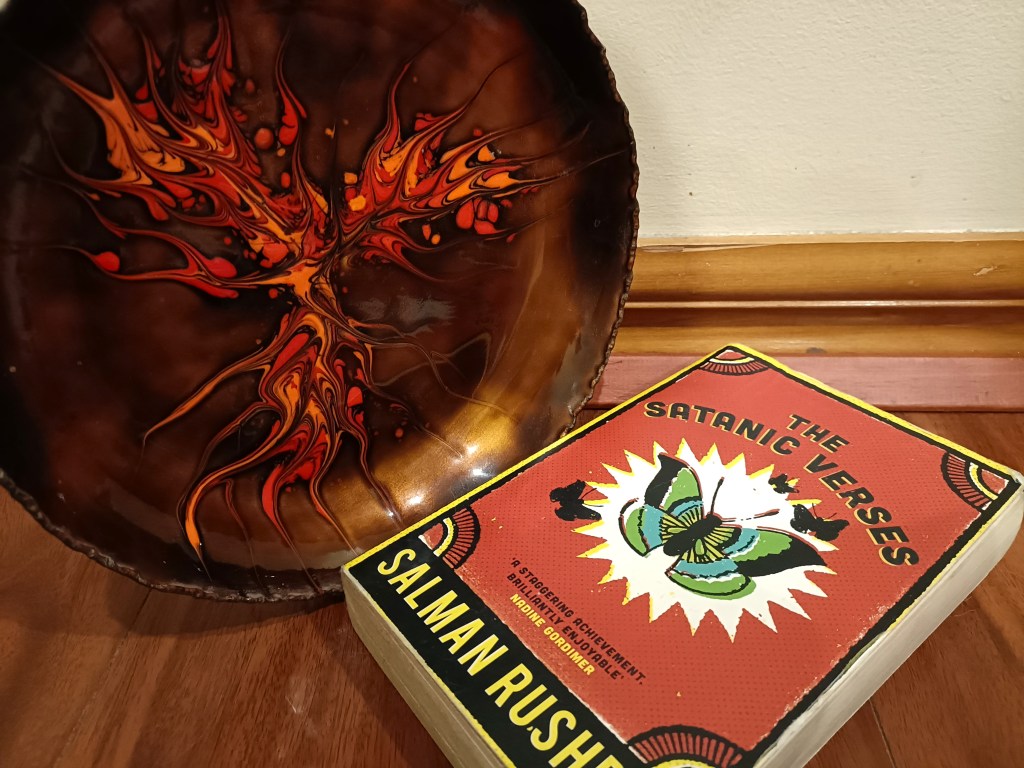
  • The Satanic Verses – Salman Rushdie

    The Satanic Verses – Salman Rushdie

    book symbol, denoting having read this as a physical book rather than in audio

    ‘In the high Himalayas, it is often the case that climbers find themselves being accompanied by the ghosts of those who failed in the attempt, or the sadder, but also prouder, ghosts of those who succeeded in reaching the summit, only to perish on the way down.‘

    I picked up this book some time after the 2022 attack that left the author seriously injured and blind in one eye. Kudos to the bookseller at the Alice Springs bookshop for pulling it out, dusting it off and placing it prominently on the shelf almost four decades after its publication. After the knife incident, buying the book felt like the tiniest act of resistance against the terrorism of murderous thin-skinned religious zealots.

    The story of the fatwa issued against Rushdie for writing this novel, and the ten years he spent in hiding as a result, is fairly well known. Less well publicised were the attacks and murders of the book’s publishers and translators in various countries, including the massacre of 37 people by a Turkish mob.

    Rushdie has been one of my favourite authors since I read Midnight’s Children in my early twenties, and a bit of a personal hero for his determined and courageous response to the threats and acts of violence against him, and his enduring commitment to free speech in the face of it all. Midnight’s Children remains my favourite of his books so far, but I’ve enjoyed all the ones I’ve read: The Enchantress of Florence, East West (a short story collection) and Haroun and the Sea of Stories (a children’s book, I realised belatedly, but a delightful read). I have a couple more on my eternal shelf.

    As such, I was excited to read The Satanic Verses – and surprised to find it a bit of a struggle. I also loved it. And I also wished it were half as long. It is a sweeping, grandiose, chaotic, absurd adventure that is at times enthralling and mind-blowing and at times a bit of a drag. It is a masterpiece, of some kind. This will be a review of conflicted emotions.

    How to summarise what this story is about? It starts with a Bollywood movie star and a (less famous) voice actor falling out of a hijacked aeroplane over the English channel after the aircraft explodes. In Rushdie’s signature magical realist style, the two British-Indians jumble in the air in a tangle of limbs before hitting the ocean and swimming to shore, their destinies now inextricably linked.

    Bizarrely, around the time I was reading this book, an Air India plane crashed after takeoff and, in an almost equally unbelievable twist of fate, one passenger – a British-Indian man – survived the wreckage, walking away with no major injuries. A haunting stranger-than-fiction parallel that makes me wonder if the world isn’t a little more magical and unpredictable than we give it credit for.

    Another storyline in the book follows the fictional prophet Mahound, who ascends Mount Cone to hear the voice of God, only to later become convinced that the words were in fact whispered to him by the devil, Shaitain. The one who whispers the verses is in fact the Angel Gibreel, sort of played by Gibreel Farishta, the movie star who fell out of the plane and acts sometimes in the role of an archangel while Chamcha, his co-survivor, grows devil horns and becomes poisoned with envy over Gibreel’s more successful career. Another storyline follows Alleluia Cone, a mountain climber who remains haunted by her conquest of Everest and cannot help, in between summits, falling into a tangled relationship with Gibreel, the sometimes-angel, who resembles more of a man-child in his waking life.

    This web of insanity is largely set against the backdrop of a racially intolerant Britain as our heroes, Chamcha and Gibreel, must navigate the new ‘immigrant alien’ identities cast upon them by virtue of having washed up on the country’s shores instead of landing at Heathrow.

    After you recover from typhoid, Chamcha reflected, you remain immune to the disease for ten years or so. But nothing is forever; eventually the antibodies vanish from your blood. He had to accept the fact that his blood no longer contained the immunizing agents that would have enabled him to suffer India’s reality.

    All of this makes for rich, and sometimes exhausting, reading. Knowing that Rushdie was inspired by his interest in ancient Islamic texts, and knowing very little about Islamic culture or theology myself, I felt in some ways unqualified to fully comprehend all the meaning contained in the characters, names, references and interlinking stories. I happened to read it around the same time as Rory Stewart’s memoir, The Places In Between, in which he notes that Islamic texts often begin with a contradictory construction: ‘it happened and it didn’t happen.’ It makes it hard to ascertain the literal truth of historical texts, but seems to imply that the story is true in the only sense that matters: it is story-true. This is a perfect allegory to magical realism, and the ‘it happened / it did not’ construction is one Rushdie uses often thoughout The Satanic Verses. I wondered how many other such nuanced references I missed out of ignorance.

    Salman Rushdie is one of those witers who both inspires me to write and fills me with despair by comparison to his brilliance. I hate to use the word ‘genius’, especially about yet another man, but it’s hard to describe the mind of this author any other way.

    The Satanic Verses is incredibly impressive, but I’d say it’s a bit more impressive than it is enjoyable – in fact, it’s kind of hard work. I read another whole book in the middle of it for a reprieve (see Once There Were Wolves) and fell asleep on three consecutive occasions trying to read one sentence that spanned most of a page. The hard work is rewarded with scenes of unrivalled creativity and sentences of sublime beauty. Among those highlights is stopping every couple of pages to look up a word in the dictionary, rereading neverending sentences to try to unravel the meaning, and sometimes feeling that the core of the story remains elusive for all the profusion of words.

    I’ll admit that the longer the reading experience went on (and it went on for a while) the more it started to feel like a chore. While I still enjoyed each reading session, a few pages generally left me sated instead of hungry for more – and there are a lot of pages in this book. Towards the end I was feeling that I had scaled the peak of the book some time ago, and was now just trying not to perish on the way down.

    This left me with the strange experience of wanting to defend The Satanic Verses as an excellent book, yet reluctant to recommend it to many (any?) of my book-loving friends and associates. As I like to do when perplexed by a book, I sought the wisdom of Goodreads and Reddit, and found a similar sentiment among Rushdie enthusiasts that this is far from his strongest work.

    So I guess my advice would be to read all his other books first and if you love them, read up a bit on your Islamic culture and religious history and your Indian culture and your 1980s British politics – and make sure your general history and philosophy is all up to scratch. And then come back and enjoy this book to its fullest extent.

    As to the mobs and zealots, I confess I came away with no strong understanding of what the religious fuss was all about. Rushdie asserts that the vast majority of the book’s opponents have never read it, and this seems highly plausible. If they had tried, they’d likely still be buried in the dictionary, scratching their heads.
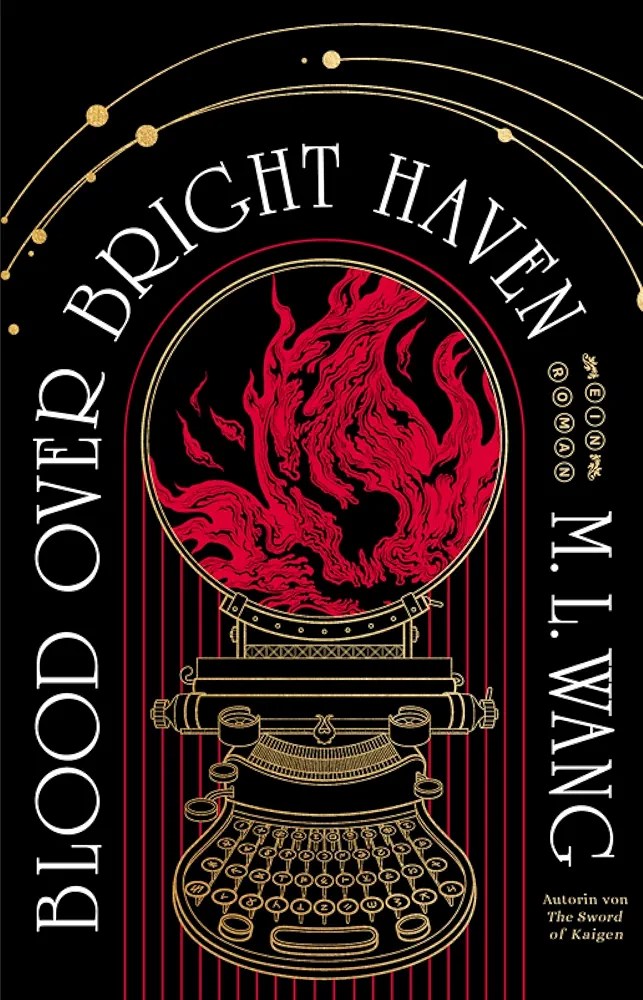

  • Blood Over Bright Haven – M.L. Wang

    Blood Over Bright Haven – M.L. Wang

    headphones denoting an audiobook review

    Audiobook narrated by Moira Quirk

    ‘Do not fear the forces of darkness, for God, who promised us this land, is with us – and his will is light.’

    Religion is truly the opiate of the masses in this standalone dark academia fantasy from M.L. Wang – the first work of hers and possibly the first (originally) self-published novel that I’ve read. In fact, although Wang seems to have achieved widespread fame and success, Blood Over Bright Haven is the first of her novels to be picked up by a traditional publisher.

    Sciona is a dedicated graduate student who seeks to become the first ever female High Mage to be admitted to the Academy. You might call her obsessive, but of course that is what drives her to go where no woman has gone before.

    This is a world of distinct haves and have-nots: the colonists and the displaced. Sciona, a mage of unusual talent who has lived all her life in the city of Tiran, is firmly seated among the ‘haves’. Thomil, a refugee from a nomadic tribe beyond the magical barrier of the city, exists on the other side of the coin, having fled from the terrible Blight that ravages his homeland. Thomil’s people, The Kwen, are second-class citizens in Tiran — objects of self-congratulatory charity at best, and walking cockroaches at worst. The book alternates between the two viewpoints, although Thomil never quite feels as much a protagonist as Sciona.

    The combination of magic, academia and fervent religiosity in this story is an unusual one, especially as the magic here is more akin to a science than to traditional magic of the witches-on-broomsticks kind.

    Even within the Academy, the bounds of knowledge are set by religious doctrine based on the teachings of Tiran’s founders. The idea of the academic study of magic (which might as well be science as it runs the trains, turns on the lights and boils the kettle) being underpinned by hardline religious belief is initially jarring. But throughout history scientific understanding has often been constrained, either by religious dogma or by the prevailing theories, politics and groupthink of the day.

    As her studies take her in an unexpected direction, Sciona is forced to confront the unquestionable tenets of faith on which her beloved magic system is based. The sexism and discrimination Sciona faces, the way truth brushes up against convenience and doctrine, the comfortable city life enabled by a servant underclass, and worst of all, the truth she uncovers, all contain clear parallels with our own world — which is the book’s strength and also its weakness.

    When Sciona tries to raise the alarm, she finds that her fellow mages and citizens of Tiran have a strong incentive to keep their blinkers firmly on. If they can choose comfort here at the expense of destruction elsewhere, or destruction here to buy comfort elsewhere, the choice is tragically simple.

    The greatest success of Blood Over Bright Haven, the way it got under my skin, was the way in which the story reveals us to ourselves. Reading it, I had the same queasy feeling I had reading The Hunger Games, when the tributes from District 12 attend a fancy dinner party in the Capital at which vials of potion are provided to induce vomiting so the partygoers can fill themselves with food, then empty their stomachs and keep on eating. In this scene we feel the horror and disgust of the tributes, who have grown up one step from starvation, while the Capital takes their produce and taxes them to oblivion. And we also feel the disquiet of thinking that the potion sounds pretty good and recalling Christmas dinners where we’ve had to lie down clutching our overfull stomachs, while political and economic forces not unlike those in The Hunger Games ensure that others in faraway countries are experiencing hunger, malnutrition and preventable disease.

    In both books, the brilliance is in the just-subtle-enough: making us hate the oppressors for their cruelty and indulgence and selfishness, before the light shifts and the mirror is angled slightly to reflect the image back on ourselves.

    In other areas, though, Blood Over Bright Haven falls a bit flat. While we can in part forgive the heavy-handedness of the feminist messaging because Sciona is living in a world significantly less progressed than ours on gender equality, it does sometimes feel like the hammer is striking this gong a little too loudly.

    Similarly, there is lacking subtlety in some of the character portraits, interactions and dialogue – particularly the largely interchangeable ‘arrogant male scholars’ of the Academy. The conflict between 27-year-old Sciona and her colleagues feels more like schoolyard rivalry and bullying than the passive-aggressive subtle undermining and power games that haunt professional workplaces. And while I’m labouring on the complaints, I felt that the world, while compelling, was underdeveloped so that I never quite got a strong picture of it in my mind.

    So are there weaknesses? Yes, absolutely. Were they enough to slow my compulsive consumption of this book? They were not.

    My only major complaint (and it is quite major) with Blood Over Bright Haven was the ending. Endings are hard. So are beginnings and middles, of course, but so many excellent stories have been ruined by bad endings, there is clearly something singularly difficult about tying all the pieces together in a way that feels satisfying but not trite. This conclusion felt like a rushed attempt to write a certain kind of ending regardless of how it fit with the plot or the internal logic of the story. One comment I read online suggested that the ending didn’t work because the real-world problems highlighted in the book have no clear solutions.

    I think this view is valid, and may have been an area where the parallels with reality let the book down. Perhaps we seek refuge in stories because they simplify the bewildering complexity of life; they make the impossible achievable, let the underdogs win with statistical improbability, and persuade us that evil can be overcome – and indeed, easily identified.

    Disappointment aside, I binged this book, listening over consecutive days as I gardened, cleaned, walked and hung out washing. The narration by Moira Quirk is solid but a tad drone-y, with a tendency to overdo character voices which I think may have exacerbated some of the weaker dialogue. I did feel, as I often do, that it was a shame this book didn’t get one more draft to polish it into the gem it should have been. Nevertheless, it seeped into my bones and stayed with me after I finished (which didn’t take long).

    After a string of disappointments, I was thrilled to finally find a fantasy book I could sink my teeth into. Blood Over Bright Haven is not by any means perfect, but it’s (mostly) very good. I finished hungry for more: Wang’s previous book, Sword of Kaigen, is next up on my list.

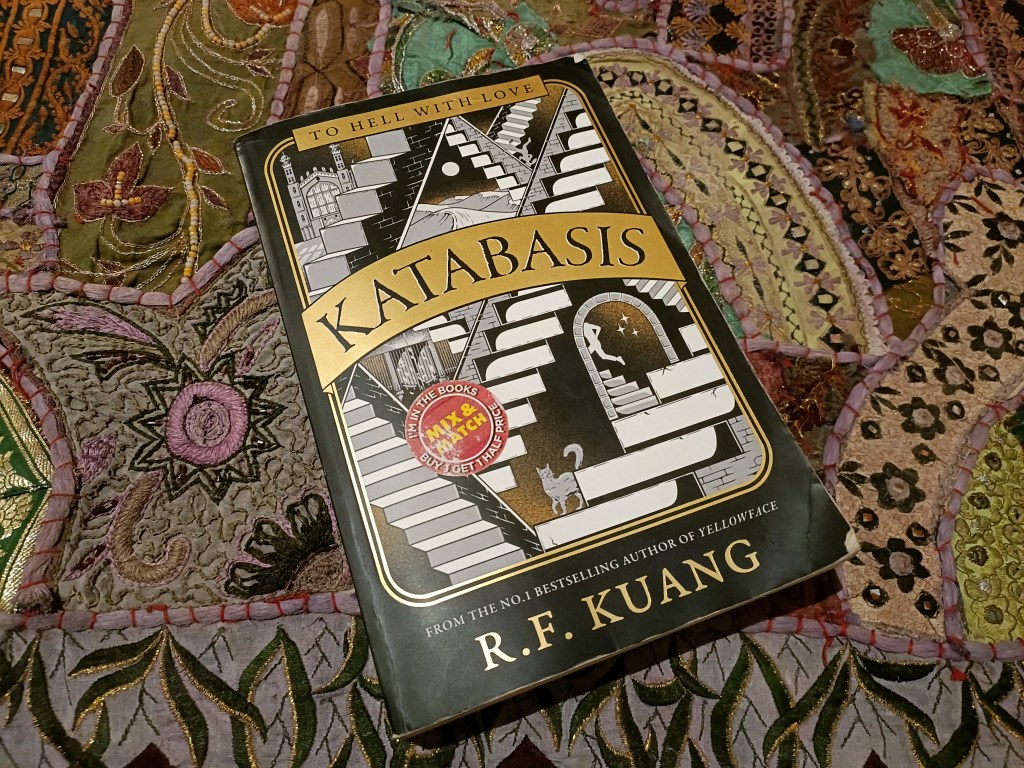
  • Katabasis – R.F. Kuang

    Katabasis – R.F. Kuang

    ‘I feel sometimes it is so difficult to be conscious… and I think that anything would be easier. Anything at all.’

    ‘There’s time for that.’ Peter grasped her by the elbow; firm, but gentle. His voice was soft. ‘It’ll always be waiting, Law. But we’ve got things to do.’

    I knew the name R.F. Kuang from her 2023 novel Yellowface, which caused a big stir but felt too tapped into the political zeitgeist to pique my readerly interest. It was only recently that I learned her primary genre is actually fantasy. Having heard positive reviews about her novel Babel, I picked up Katabasis with interest when it ended up in my luggage as the result of a buy-one-get-one-half-price deal at the airport.

    It should also be said that Kuang is a ridiculously successful writer and person, who published her first novel at 22 and has now, at the ripe old age of 29, published six novels, with more in the pipeline, and earned herself a Nebula and a #1 spot on the bestseller list of the New York Times. Somehow, while becoming a prolific bestselling novelist, she has earned two Masters degrees and is on her way to a PhD at Yale. These facts alone might be enough to compel you to pick up one of her books, and from the beginning of Katabasis there can be no doubt that it’s written by a very clever author.

    Some combination of fate and algorithms led me into the dark academia genre, as it often has of late, with this tale of two graduate students on a jaunt through Hell to retrieve their recently deceased thesis advisor. Alice and Peter are fellow students in the Academy of Analytic Magick, specialising in linguistics and logic respectively, and it’s clear they have a history to be teased out.

    A journey through the underworld for the sake of a PhD sounds like a fun premise, and in fact journeying through Hell and back and sacrificing half a natural lifespan seems to function as a fitting metaphor for the process of obtaining this notoriously gruelling credential.

    Katabasis has a lot to say on the state of academia, the tendency of advisors to steal their students’ work, and the role of women within this system that infamously lags behind modern expectations of gender equality. Kuang’s biting, satirical commentary on the quirks of academia and elite universities is fun to read. There is some excellent and nuanced exploration of femininity, sexuality, sexualisation and what liberation means. Desiring to be desired, without desiring back, for instance, or desiring the freedom to flirt with one’s professor, free of the obligation to sleep with him. But the backstory about campus life (which accounts for about half the book) is told as highly narrated flashbacks, which gives it all an unfortunate sense of emotional remove.

    Even so, the university is where most of the interest lies, whereas the Underworld is, ironically, a bit of a drag. Kuang’s vision of Hell seems more closely modelled on the endless trek to Mordor than on the fiery pits of Mount Doom. Alice and Peter wander through the eight courts encountering a big wall, some violent bone-piles and mostly vague and uninteresting dead ‘Shades’, but nothing for the most part to cause much concern. In fact, there was so much of nothing in Hell that when real peril did come knocking, I was too surprised to process what was happening.

    There’s a lot of wit here: Hell in fact takes the form of a university campus, where Shades spend centuries in a purgatorial state, writing essays examining their sins in the vain hope of being granted reincarnation by unknown and unseen deities, putting off a permanent ending to existence. They fuss over minute details of philosophical argument, spending decades trying to get the wording just right, only to acknowledge that they have never seen anyone actually pass this test or receive any feedback on their attempt.

    Peppered throughout are constant references to philosophy thought experiments, paradoxes and logic puzzles, which play an important role in magick – which seems to mostly consist of drawing chalk circles and imbuing them with some combination of equations and language tricks to make unlikely things occur.

    While interesting on their own, these constant references to philosophy probably end up distracting from the story more than driving it. Yes, an obscure thought experiment combined with some magic chalk might be enough to get our heroes out of a sticky situation or two, but ultimately it feels more like hearing an annoying kid in class constantly bringing up Plato and Kant and Heidegger more to show off how much he knows than to add any value to the conversation.

    Because most of these concepts cannot be explained in a few sentences, you really have to be already familiar with them in order for the references to mean anything or their relevance to the story to make any sense – which rather narrows the pool of potential readers suited to this novel. And then, if you are familiar with the concepts, they’re not explored in enough detail or with any real novelty that would make them particularly interesting to read about other than nodding and going, ‘Ah, yes, Monty Hall – ah, yes, Pascal’s Wager. Mmm. Indeed.’

    Once, in school, I took part in a kind of ‘puzzle-a-thon’ where we had to solve maths and logic puzzles as a team against the clock. Reading Katabasis often felt not like participating in one of these, but like standing watching it through a window and having the puzzle-solving activity described to you.

    The story almost suffers more because of all the clever ideas contained within it than in spite of them. The characters never fully came to life for me; the stakes never seemed high enough; the whole concept of magick felt sort of irrelevant. Hell was a bit too sandy and monotonous and the whole thing had some of the feeling of all the late night pub conversations you had with your friends at uni, pulled and pummeled into the format of a novel. It was a much longer book than its contents justified and, while always an enjoyable reading session, ended up being a bit of a grind to get through.

    I guess not all magick has that magical feeling, and Hell might just be a place where nothing ever happens. (But yes, I will still be putting Babel on my reading list. And maybe The Poppy War Trilogy, too…)

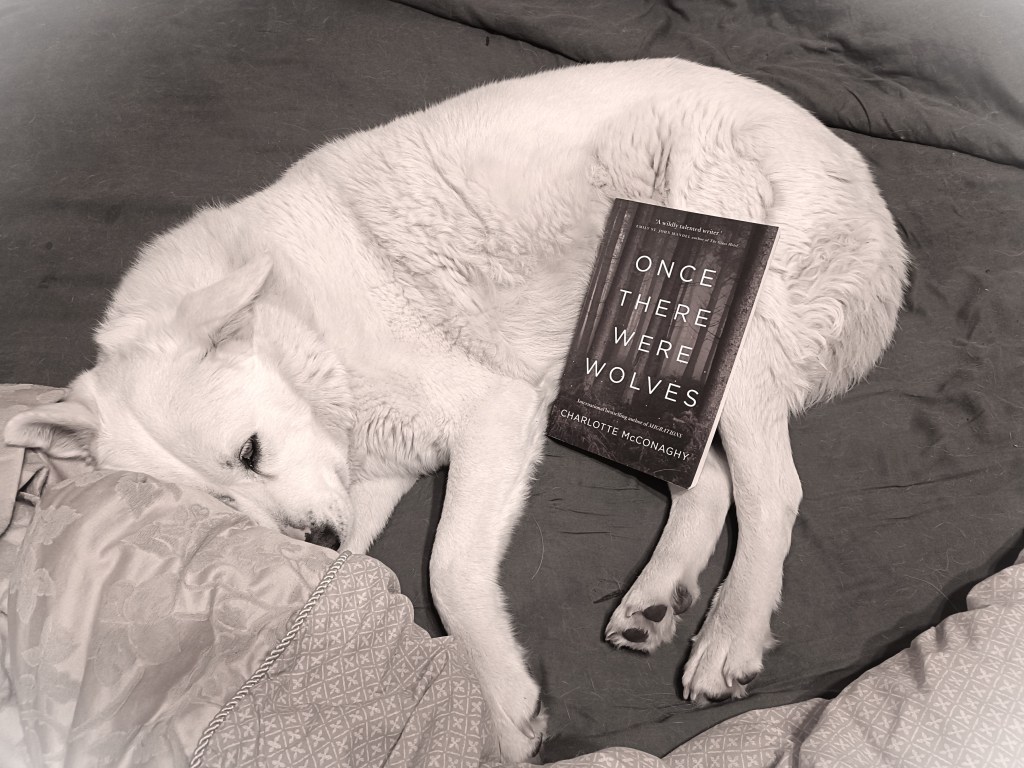
  • Once There Were Wolves – Charlotte McConaghy

    Once There Were Wolves – Charlotte McConaghy

    ‘Death gets under your skin, you carry it with you. People can sense that.’

    This was a Christmas book from my father-in-law, who usually chooses well. This book was a particularly good choice for me given the subject of rewilding that forms the basis for the story. In fact, last year I visited the Dundreggan Rewilding Centre in Scotland, which gets a mention in the book, and the Cairngorms, where the story takes place, and will happily chew anyone’s ear off about nature, conservation and rewilding.

    The second offering from Australian author Charlotte McConaghy, the story follows Inti, an Australian wolf biologist leading a pilot project to reintroduce wolves to the Scottish highlands as part of a rewilding effort to naturally control deer populations and restore the balance of the forest ecosystem.

    By some coincidence, this was the third book I read this year dealing with rewilding in the UK. The other two were both non-fiction books that approached the subject from opposing perspectives. The exploration of the topic in a fictional setting was a fascinating blend of the two, because of course nothing is ever so simple in the land of stories (which is to say real life).

    Inti is more an animal-person than a person-person – prickly, brusque, call-a-spade-a-spade – and we follow her as she ricochets around this small rural Scottish town raising eyebrows and making enemies among the local farming population who see the wolves as a threat to their livelihoods and maybe even their lives.

    McConaghy is undoubtedly a talented writer and Once There Were Wolves had more than enough plot and intrigue to keep me engaged – almost too much plot and intrigue, perhaps.

    I read this as a side-quest halfway through Salman Rushdie’s The Satanic Verses after one more late-night reading session in which I found my eyes and my brain simply unable to follow the complex, chaotic magic-realist world. I found myself picking up this book four times out of five over that one until I’d finished it (I’m still only two-thirds through The Satanic Verses). Who among us hasn’t succumbed to the allure of a highly readable book with an intriguing yet simple plot over an undeniably better book that takes up much more brain power?

    Yet it would be deeply unfair to paint this as a mindless page-turner. There’s some beautiful writing and thoughtful consideration of her topics and themes. There is much darkness, which is a big part of its eerie appeal. The wolves aren’t the only danger lurking in this place. Violence is a consistent theme and McConaghy is an expert at foreshadowing and revealing just the right amount at just the right time to keep me absorbed and turning the pages.

    As with a lot of the new Australian fiction I read, I felt that in parts a talented writer was let down by inadequate editing. Parts of the novel read like a near-finished draft to me. Side characters often felt like cut-outs and lengthy passages of expositional dialogue fell flat. I felt there were scenes that should have been summaries and summaries that should have been scenes. I was surprised to learn that McConaghy actually studied screenwriting, especially as I thought the descriptive prose was the strongest aspect of the writing and the dialogue the weakest.

    I wanted more Scottishness from the book, more culture clash, more sense of the place as somewhere Inti didn’t fully understand. It was easy to forget where we were, though the rural highlands setting and Inti as an outsider had promise to be one of the book’s draws.

    I wanted less explanation of rewilding and forest ecology for the reader. While the uninitiated would be going in cold and may appreciate some of this, readers who already understand the basic concepts and arguments will probably skim these passages as I did and wish the author had found a niftier, subtler way to ‘educate’ the reader on the topic as required without making her characters give each other the 101 in awkward monologues.

    Still, sometimes I worry that studying the craft of writing has made me pick things apart that once I would have breezed over. I just came away with the sense that this was a great book that deserved to be a little better.

    As the plot develops it twists and turns, accelerating towards the finish so fast you’ve barely turned a corner before the next curve hits, taking you in another direction. By the end I wasn’t entirely sure what I felt about the resolution and the many revelations, but I appreciated the wild ride. As to whether I’d read another book by this author, once I sink into the first page, I’m guessing I won’t be able to help myself.

    Responses

    1. fullytreefa35a150bc Avatar
      fullytreefa35a150bc

      Hear hear! What are Australian editors doing? Sometimes it’s like the book doesn’t go through that process at all.

      LOVE the photo with Cinna. What a treat. Please don’t rewild Cinna in Scotland!

      Interesting pick up that the author was a screenwriter. Poor dialogue in these types of books is very disappointing. By ‘this type of book’ I mean 300 page long – I am guessing at the length here – modern Australian novels that refuse subtlety and rely on dialogue.

      I’ll likely wait for the ABC miniseries for this one based on your review. Her new book has been getting good reviews so hopefully she’s improved.

      Happy Easter!

      Ps Fatherinlaw book presents are always fun.

      Like

      1. scrthomson Avatar
        scrthomson

        Yes, I suspect it’s all about economics. Having had a couple of stabs at writing novels, I can say it’s a ridiculously difficult endeavour and even books with good bones likely often need a LOT of editing to reach their true potential. I’m guessing that there just isn’t the money in the Australian industry to give the amount of time and attention that’s really needed to the editing process. It’s always a shame when you read a good book that just needed a bit of polishing, but having said that I still found this a really engaging read overall. Oh, and I think Cinna would love to be rewilded in the highlands for a few hours – until she feels like coming back to curl up on her queen bed.

        Like

        1. fullytreefa35a150bc Avatar
          fullytreefa35a150bc

          Can the authors not edit their own work? I would have thought part of writing multiple drafts would be to address structural issues like dialogue. Surely the author knows it is a problem, as good authors generally should be good readers too.

          Like

    2. scrthomson Avatar

      For sure there would be multiple drafts but as the author sometimes you’re too close to the work to see clearly what is and isn’t working well. I wonder if someone trained as a screenwriter just has a higher tolerance for expositional dialogue as well, because in film you don’t have too many other tools available – although you still need to figure out how to be somewhat subtle about it.

      Like

  • Why The Next Shelf?

    Why The Next Shelf?

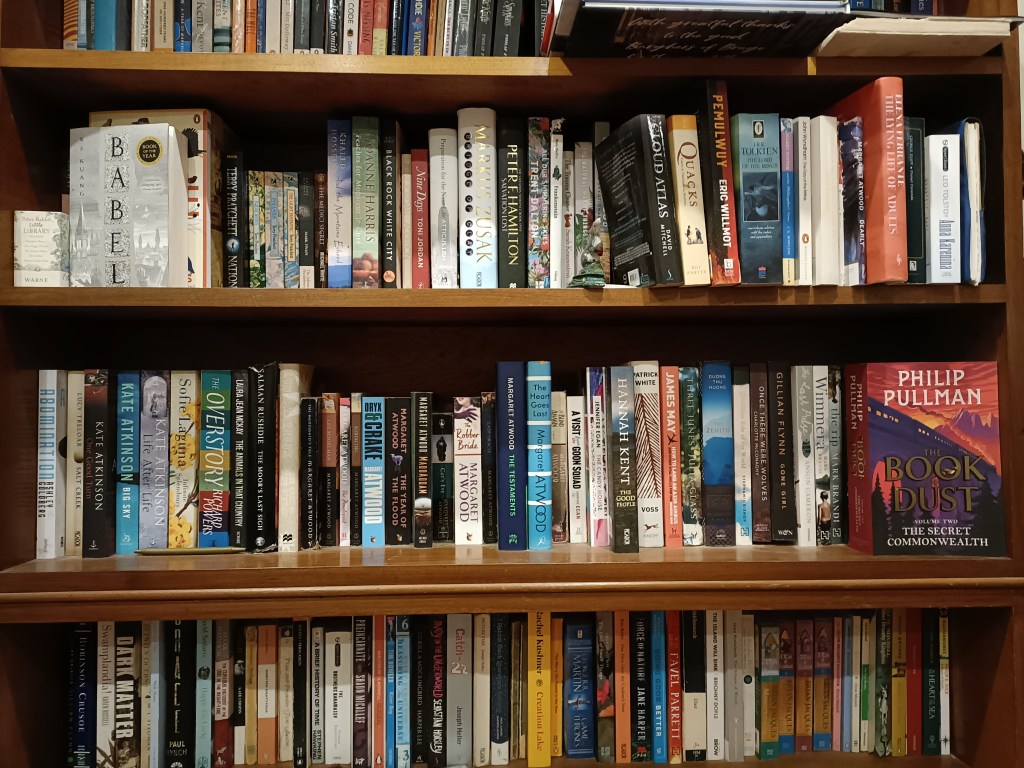
    A photo of my actual bookshelf, overflowing and double-stacked

    There are three scents in the world that I can’t get enough of: forests, where damp compost mingles with new flowers and eucalypt; churches, with their candlewax and incense; and the smell of a book.

    The first thing I do when I start a new book is open it and smell the pages. The older and more loved the book, the better. I started doing this with my Harry Potter books when I was young and re-reading them for the 15th time.

    It was a grounding, calming action that immediately began the transition between worlds, the descent through the portal opened up within the page, absorbing me into the ink. The walls around me would shimmer and sway and disappear and in their place would be a castle, a forest glade, a distant planet, a land far far away.

    Every day I look at my bookshelf and I get excited about all the books I’m yet to read and I grieve the ones I worry I’ll never get to. I’m filled with angst about the brevity of life and the vastness of the collection of books I want to read – including the ones I don’t yet or may never even know about.

    Perhaps a week after I first drafted the above paragraphs about the smell of books, I had the pleasure of seeing Eddie Perfect’s stage rendition of Beetlejuice in Melbourne. The production contains one of my favourite-ever lines:

    There are two types of people in this world: new-car-smell people, and old-book-smell people. We are old-book-smell people!

    I guess I don’t need to elaborate on which camp I sit in.

    Over the course of my writing ‘career’, many people have told me, ‘you shouldn’t write for other people – just write for yourself’.

    I don’t hold with this advice in general. Of course, if you want to write purely to immerse yourself in the experience, that’s a wonderful thing. But don’t kid yourself (unless you’re a very, very special unicorn) that anyone is ever going to want to read your journal.

    It seems sensible to me that if you want your work to be read, you need to write it with the audience in mind. On the other hand, if you’re writing for enjoyment or self-therapy, write with only your own goal in mind.

    For the most part, I prefer to write things that I think might eventually be read by other people – even if they never are, I get more satisfaction from thinking that one day my work might provide interest or enjoyment to others (ironically, most of my creative writing has never seen the light outside my window).

    The Next Shelf is a different project, one that is really an exercise in self-indulgence. I really just want to write down my thoughts about the books I am reading and use it as a way to continually practise and develop my writing – and reading – craft, albeit within a narrow format.

    I don’t expect that anyone else will want to read this blog, but if, like me, you are obsessed with books and find yourself short of opportunities to discuss books with others who have read the same ones, or if you’re looking for recommendations (or anti-recommendations) then you might perhaps find some value here and I would welcome the company.

    Starting this blog at a time when I am both searching for employment and trying to break into freelance writing, rejections and judgements of being ‘not good enough’ form such a core of my daily experience that it’s refreshing to create a space for myself where there is zero intention or expectation of pleasing anyone else and any number of readers above zero will be counted as a gift.

    So there it is: this is a place for me to have a one-way discussion about books, although I will be surprised and delighted by any interaction via comments with further thoughts, disagreement or suggestions from anyone with the interest and time to follow along.