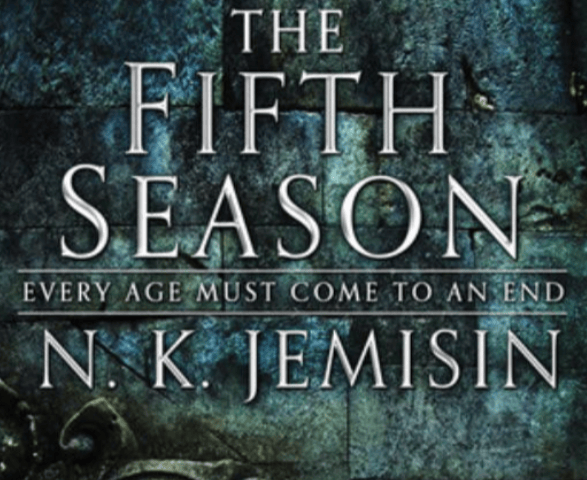

Audiobook narrated by Robin Miles
“You certainly weren’t expecting to have to deal with the end of the world, on top of everything else.”
In the Stillness, apocalypses are not especially abnormal. Planet-wide cataclysms called ‘Seasons’ occur every few centuries, caused by volcanic or seismic activity or some other major environmental change. Each Season deeply alters, or even wipes out, large portions of human life. A Fifth Season is an extended winter, lasting over six months.
The land is a character in The Fifth Season: a living, breathing, gaseous, occasionally rageful mass to whose whims and tantrums its inhabitants are subject. There are people who can control this land, manipulate its seismic, thermal and kinetic energy to quell or enhance seismic activity.
While you would think these people would be prized for their land-calming abilities, not everyone who has this power uses it well or wisely or with appropriate training and control. Hence ‘orogenes’ are reviled and feared throughout the land. They live in hiding, in perpetual danger, or else within the Fulcrum, where orogenes are trained into servitude.
Of course, this is a story about orogenes. Three orogenes in particular, on three journeys.
Damaya is a young girl taken from a neglectful family to be trained in orogeny at the Fulcrum. There she will learn to control her powers and use them in service to its Guardians.
Syenite is a recent Fulcrum graduate who is sent on a mission together with a powerful alumnus. They are given a dual purpose: to investigate a mysterious occurrence in a coastal settlement, and to procreate. The Fulcrum needs more orogenes to train.
Essun is on her way to find her husband and daughter. She wants to bring the daughter safely home and kill the husband who took her, after murdering their son.
This is not a happy book.
The Fifth Season and its two sequels have gained high status in fantasy circles, all three winning Hugo Awards. But the genre is actually hard to define: it straddles science fiction, fantasy and dystopia, but doesn’t quite fit the conventions of any one of those, and reads more like literary fiction. It may be the first book I’ve read with the official designation of ‘science fantasy’. First and foremost it’s a study of humanity.
There’s a gentleness to the style that belies the content. This is a book full of rage, disappointment, cynicism, nihilism, fear, loathing, oppression: a display of the very worst humanity has to offer, and not much in the way of redemption. It’s beautiful and terrible and not an easy read.
Rescued from her miserable family existence, Damaya’s ‘Hogwarts moment’ is short-lived. Her new Guardian is gentler, kinder, more attentive to her needs, more respectful of her humanity, and also much more sinister than the family she left behind. Once at the Fulcrum, she has only to play the good student and survive. She has no friends, no purpose, no dreams and no vision for the future.
Syenite is jaded, probably depressed, as is her travelling companion, Alabaster. Effectively slaves to the Guardians, their lives are almost entirely devoid of meaning or pleasure. They dutifully and joylessly attempt to conceive the child together that the Fulcrum requires, enjoying neither the process nor each other’s company.
Essun is the only one of these characters with any agency. Unlike the other two, who spend most of the story doing what they are told, she is driven by her own powerful purpose. Kill husband. Find daughter.
There is much to commend in The Fifth Season. Jemisin’s lilting prose has an absorbing quality. Her observance of human nature, particularly of the darker aspects, is deeply moving. Damaya’s Guardian, Schaffa, is drawn with bone-chilling perceptiveness and subtlety. The contrast between his manner and his nature is wonderfully executed in a perfect portrait of coercion. He tells Damaya he loves her. He tells her she’s special. He tells her he will look after her – as long as she does everything he says. He is not quite evil; he just serves a higher purpose, as does everyone at the Fulcrum.
Themes of otherness, of persecution, of freedom and identity are elegantly explored. The way Jemisin brings the three stories together right at the end of the book is mind-bogglingly clever, and almost made me want to turn right back to the start and re-read it all with a new lens. The reading (listening) experience was strangely mesmerising, like a slow current that sweeps you up and carries you along. But once deposited on the shore, I wasn’t quite sure how I got there or how to feel about the journey.
Jemisin didn’t give herself an easy task. How to keep readers immersed in a book so full of darkness and despair? She does an impressive job of making the darkness beautiful enough to be compelling. Still, for a book so character-driven, I wanted to be more invested in those central characters – to identify with them, to hope and fear for them, to become them – but I somehow felt them always to be kept at arm’s length.
Unusually, I found myself becoming less interested in the story as it progressed. Though many fans clearly disagree, I felt it failed to capitalise on the potential of an enthralling setup. Plot development was slow and meandering, and while I was fine with this being a more ‘literary’ fantasy read, there were plot-promises that could have been much more satisfactorily resolved, elevating the story and giving the characters more opportunity to develop.
I feel bound to add some qualifiers to these criticisms, though, which have to do with my ‘reading’ it in audio format. While the narration by Robin Miles was done well (albeit with an American accent, have I mentioned this should be banned?), I reflected afterwards that this is not a book that lends itself well to audio. I often turn to audio for fantasy reads as they tend to be more plot-forward, but this is not a plot-forward book. I found over time that those small moments of inattention while multi-tasking or drifting off to sleep were detrimental to my understanding of the world Jemisin was building, the subtleties conveyed in the readings of the lore that are interspersed every few chapters, and exactly how things were tied together.
It was, in fact, only after finishing the book, trying to write this review and realising I was somewhat confused about the details of the Seasons, the Stillness and the lore of the book’s universe that I learned the audiobook in fact comes with an accompanying PDF that includes the appendix and glossary that go with the text version. Even so, the audio version doesn’t include the map from the physical book, which shows the supercontinent of the Stillness with all the tectonic plates and faultlines and the places that make up the journeys of the different characters. As fantasy aficionado knows, any great fantasy book must be in want of a map and a glossary, so I couldn’t help feeling I’d missed out on the proper experience.
I suspect I would have enjoyed the book more in physical form; I would have been more immersed, paid closer attention and appreciated more of the detail. This isn’t a book that grabs you by the horns and doesn’t let go. It reins you in and leads you gently, but you have to watch your footing and follow closely.
Even so, I find it hard to know how to judge this book which was so impressive and such a work of beauty, and yet left me insufficiently engaged as to be unsure whether to continue the series. It’s an odd thing to say after reading only book one of three, but I’m tempted to suggest The Fifth Season might have worked better as a standalone book with a more tightly structured plot. Plot-wise, at the end of book one, I had no real sense of what books two and three were heading towards.
Trilogies are for epic quests and characters you want to call in sick to work to spend more time with. The Fifth Season had the kind of pleasant dreaminess that accompanies a bad cold: there’s something nice about being huddled in a blanket on the couch in a kind of alternate state, but it’s not one you’re left in a hurry to re-enter.
 The Next Shelf
Leave a comment