
“If you are playing a part, you will never keep it up unless you convince yourself that you are it.”
I’ve belatedly declared this the year of catching up on classics. Expedience demands that I make it a financial year rather than a calendar one, and most likely I’ll need half a decade or so to really get caught up, but we have to start somewhere.
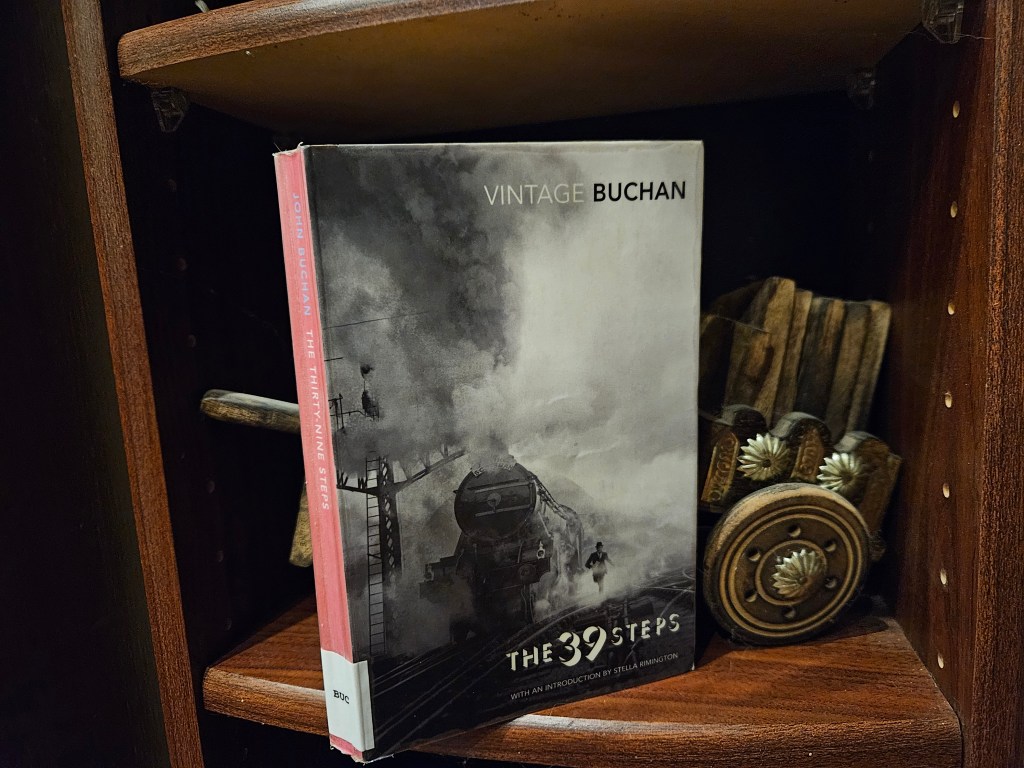
I had never in fact heard of The Thirty-Nine Steps until it was recently featured on ‘The Book Club’ podcast, which has been instrumental in my realisation of just how few of ‘the classics’ I have actually read. It was described as a book you could conceivably read in an evening, and which would constitute an evening well spent. That was all the encouragement I needed to reserve it at the library.
Of course, slow and otherwise-occupied reader that I am, it took me several weeks of evenings to get through it.
Published in 1915, the book gained great popularity among the WW1 troops and features a timely and bizarre plot about sinister Germans impersonating respectable British gentlemen in a conspiracy to take down the whole of Europe. Attesting to its popularity on the front, one officer apparently wrote:
‘It is just the kind of fiction for here. One wants something to engross the attention without tiring the mind.’
Buchan called The Thirty-Nine Steps a ‘shocker’ – what today we would call a spy thriller. Richard Hannay returns from his work for the Colony in South Africa, excited to live large in London, only to find himself unexpectedly bored stiff. On this account, when a nervous stranger bursts into his flat, drinks all his whiskey and starts telling him about the death he plans to fake to avoid being killed, Hannay is immediately in for the ride. Luckily for Hannay, as he embarks on a wild caper about the Scottish countryside, he’s not the only man whose sense of adventure and goodwill is tickled by a fugitive seeking refuge.
The Thirty-Nine Steps is pretty bonkers, and unapologetically so. When I finished it I turned straight back to the start and started leafing through again, trying to piece the plot together retrospectively from beginning to end, wondering what I had missed. I then read the introduction, which states:
“It doesn’t matter that the reader has no clue where he is being taken or, when he gets there, how the thing could have happened as it did. No matter either that he might secretly suppose that Buchan had no idea either.”
– Stella Rimington
Occasionally at the end of a movie I turn to my husband in confusion about some key plot point. He usually tells me it was all very obvious, wasn’t I paying attention at all? On further interrogation, he’ll tell me I’m thinking too hard about it. I figured that in trying to make sense of this book’s plot, I was thinking too hard about it.
It’s perfectly harmless fun. It also reminded me why I don’t often read in this genre. The Thirty-Nine Steps fell quite squarely for me into that bucket of fiction that offers a good rollicking adventure yet has me asking all the way, ‘but why do I care?’
I suspect the preference for stories that are more character and relationship based is a gendered one, but this is also what I would call an early example of ‘bro-fiction’. By men, about men, for men. Hannay is often described as a precursor to James Bond, with a few key differences. Where the Bond books revel in outright misogyny, The Thirty-Nine Steps is oddly sexless, featuring almost no female presence whatsoever. It’s less that Richard Hannay is uninterested in women as they simply don’t seem to exist in his world. Apart from one old farm wife who obligingly and wordlessly helps him out on the road, I’m struggling to recall any female characters in the novel at all.
This alone would not necessarily be a problem. The nonsensical plot is not necessarily a problem. Hannay is a likeable enough hero, plucky and adventurous and out to save the day for Mother Britain. The jaunt through the countryside in various disguises is fast-paced and enjoyable. My main issue with this book, as with many other examples of the genre, is that the rapidity of action does not translate into narrative tension, because the stakes are unclear.
Had the plot been more decipherable, Hannay’s mission to save Europe might have felt more important. As it is, his actions feel motivated more by boredom than anything else and his attitude is so perpetually chipper that even when things look extremely dire for him, there is never any real felt sense of danger. He has no friends or family to fight for or return to, and the nature of the threat posed to the continent by his mysterious adversaries is murky at best.
I have always struggled with novels that don’t take themselves seriously. It’s why I believe that Terry Pratchett was surely a genius and yet have no real desire to read any of his books. It’s why I can do multiple re-reads of a slightly cringey, poorly written YA series that nevertheless gets me invested in the characters’ lives and genuinely caring about the outcome.
In other words, perhaps, The Thirty-Nine Steps is a book of a particular genre that is not my particular cup of tea. Still, this is the kind of classic that I can only assume is recommended not because it’s a timeless masterpiece, but because it’s ‘part of the canon.’


Leave a Reply