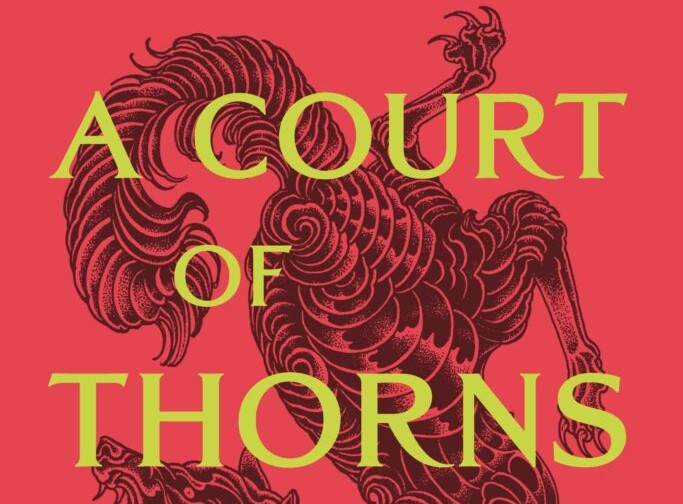

Audiobook narrated by Jennifer Ikeda
‘Do you have a plan?’
‘No.’
There are good books and bad books and in-between books. There are so-good-you-want-to-make-everyone-read-it books, and there are so-bad-you-want-to-warn-everyone-to-avoid-it books. There good books that you plough through and excellent books that you struggle to find the energy for, books that are unreadably bad and books that are plain dull. And then there is the special category of books that are so bad they’re almost good. A Court of Thorns and Roses is not the worst book I’ve ever read, but it might be the best-worst.
This title, the first in the ‘ACOTAR’ series, as it’s known within the cult, had been a stalwart in my ‘maybe to read’ pile for a couple of years. I was pretty sure it was rubbish, but it had been recommended by at least one person with some crossover in book-taste and I’ve avoided books before out of snobbery that I’ve ended up enjoying. So when I saw it on the lineup for the excellent ‘The Book Club’ podcast – and mistook a jocular reference to it as one presenter’s ‘favourite book of all time’ as a sincere endorsement – I decided it was worth taking the plunge for what was sure to be an easy listen.
Jennifer Ikeda, despite her unfortunate American accent, does a decent job of the narration, probably working the source material about as well as anyone could.
Sarah J Maas wrote her first book, Throne of Glass, at age 16 and has amassed a serious cult following with her ‘romantasy’ series, blending high fantasy with adult romance. The first three-quarters of this book is basically Beauty and the Beast reimagined as a gothic bodice-ripper. Throw in some Fae folklore and a few more mythical creatures, Disney tropes and vaguely sketched Fae court politics (and some slightly more explicit bodice-ripping), and you have yourself a global phenomenon and multi-million copy bestseller. The last quarter or so of this indefensibly long slog feels more like a classic fairy tale with twenty-first century teenagers. But there is actually a fair bit of plot here, so I will try to briefly summarise.
Nineteen-year-old Feyre lives with her two older sisters and crippled father in a small cabin on the edge of the woods. Armed with bow and arrow, she hunts to keep her family fed. When one day she kills a giant wolf who turns out to have been a faery in beast-form, payment is demanded and she is taken to live a life of imprisonment in the Fae realm of Prythian (modelled on ancient Britain).
What follows is mostly a parade of confusing mythical creatures who inevitably come after Feyre after she repeatedly ignores instructions for own safety – which of course requires her to be rescued by her captor, the High Lord Tamlin, a shape-shifting man-beast cursed to live under a mask, even in human form. Between them slow-boils a hot-blooded love affair, complete with claws, growling and many uses of the words ‘feral’ and ‘predatory’. But in time, Feyre finds that nothing is what it had seemed in Prythian. To rescue her beloved, she goes boldly into the court of evil Queen Amarantha with no plan whatsoever, and finds the fate of the world balanced in her highly incapable hands.
Like Dragonflight, A Court of Thorns and Roses is quite good as a plot summary. There’s actually a lot going on, but unfortunately it mostly happens off the page. Most of the consequential events and background are narrated through expositional dialogue – and then further explained, just in case you missed it. It reminded me of the new breed of Netflix content produced under the explicit assumption that viewers will be on their phones throughout and only half paying attention. ACOTAR was published in 2015, but had it come out this year I would have seriously questioned if it was written by AI – especially in the light of revelations that many romance writers are already embracing this new technology to spit out over 200 books a year.
The writing is incredibly childlike, which is an odd juxtaposition with the ‘adult’ content (although it should be said the bodice-ripping mercifully took up much less real estate than I’d expected). There is no subtlety to be found here; no complexity, no nuance, no subtext. Everyone will tell you exactly what they think, and then go to great lengths to explain what they meant by it. The characters are flimsy and the worldbuilding feels thin. The narrative is riddled with inconsistencies, crater-sized plot holes, baffling decision-making and nonsensical sequences of cause and effect. Though the emotional stakes should be high, I could never take anything seriously enough to feel invested in it. I found myself bemused by the supposedly terrifying monsters and the sheer stupidity of basically everyone and everything.
“He could have had me right there on top of that table. I wanted his broad hands running over my bare skin. Wanted his teeth scraping against my neck. Wanted his mouth all over me.“
‘I’m trying to eat!’ Lucien said as I blinked, the air whooshing out of me.”
Which leads to my designation of ACOTAR as the best-worst book.
Despite the atrocious dialogue, the nonsensical plot, the inconsistent world and idiotic characters, there was somehow enough here to have some fun with. It gave me plenty of (mostly unintended) laughs, and I’ve come to believe that a terrible book beats one that is merely uninteresting. If this book has a saving grace, it’s in the pacing, which keeps the story moving along swiftly enough that you always at least feel like you’re getting through it (albeit making use of the speed-up setting in the audiobook and despairing at the number of chapters still to go.)
I was determined to finish it out of curiosity (and because I’d paid for it) and so that I could follow along with the ‘Book Club’ episode. As soon as I finished, I tuned in to the podcast, eager to hear the hosts mock and tear it to shreds. Imagine my horror and disappointment when they instead tried to be very fair, assessed it for the light fluff that it is, and both rated it 6/10 – one host raising eyebrows by rating it higher than the Steinbeck classic East of Eden.
Every now and then Sarah J Maas surprises with a sentence, a character arc or a plot twist that makes you think she could probably write something decent if she tried. It’s obvious this book was written quickly, but when I learned Maas had written it in five weeks, I was actually forced into grudging admiration for the output, given just how quickly she slapped it together.
Many of the most avid ACOTAR readers seem to be people who are just getting into (or back into) reading for pleasure, and if Maas’s work not only brings joy and excitement but also acts as a gateway into a fulfilling reading life, that can only be a good thing. I couldn’t help making comparisons to Australian author Juliet Marillier, whose book Daughter of the Forest remains an all-time favourite of mine, also heavily inspired by Celtic mythology. Although Marillier’s fantasy romance books are certainly formulaic, they are beautifully written with real emotional stakes and well-developed characters. I hope some ACOTAR fans will find their way to her.
There has long been the kind of commercially successful genre book that worships at the altar of substance and throws style out the stained glass window. There are highly prolific authors like James Patterson essentially running book factories with teams of junior co-authors. I’m not going to argue with the millions of people around the world who have showered adoration on this book and the ACOTAR series.
Sarah J Maas is clearly onto a winning formula and good luck to her – but having dipped my toe into the world of the Fae, I was left with no desire to become a permanent resident of Prythian and offer up my brain in sacrificial worship to Queen SJM at the ritual bonfire.


Leave a Reply