
Audiobook narrated by the author
‘In many houses, the only piece of modern technology was a Kalashnikov, and the only global brand was Islam.‘
Every now and then you come across a book that makes you want to run down the streets, waving it in the face of everyone you pass.
It’s not that this is the most incredible book ever written in terms of its craft or the sublime beauty of its prose, although it’s certainly impressive. But I’m a sucker for a great story, potentially especially so for a great true story. Rory Stewart is a former British diplomat and politician and now co-host of The Rest Is Politics podcast. Something about the idea of an upper-class politician completing a journey worthy of the explorers of old, and actually writing a good book about it, is so unlikely that it makes this work even more intriguing.
I’m not generally a big reader of memoir or travel writing or narrative non-fiction—in fact, this might have been the first travel memoir I’ve ever read, and possibly my lack of familiarity with the genre contributed to my unexpected pleasure in devouring this book. My father-in-law, who has read many more intrepid travel stories, described it just as ‘okay’. He had better recommendations, which have been already lost to memory, though I’m sure I’ll find them in his bookshelf eventually (my ‘next shelf’ is now apparently extending into other people’s houses). In the meantime, I’m allowing myself to call this a must-read.
When I’ve occasionally tried my hand at keeping a travel journal, all I learned from the experience was how dull an amazing trip full of wonder and beauty can become when written down after the fact. Your holidays are kind of like your kids: not that interesting to other people. This is not that kind of travel memoir.
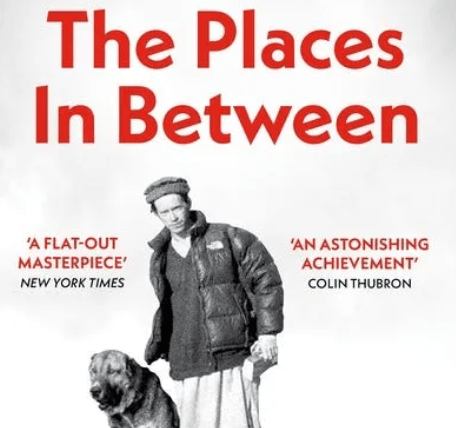
In The Places In Between, Rory Stewart narrates his solo trek through Afghanistan in 2002, during the war which his country was playing its part in waging within its borders. He sets off from Herat just weeks after the Taliban’s departure.
Following in the footsteps of Babur, the first emperor of Mughal India, Stewart seeks to re-tread this ancient path, walking every step of the way from Herat to Kabul in a straight line through the central mountains. No cheats: no car trips, no donkey rides, no camels, horses, planes or piggy backs. This takes him through perilous snow-covered mountains and remote villages completely disconnected from the outside world, even from the cities of Afghanistan itself—a route thought to be impossibly dangerous for anyone to attempt, let alone a Brit in wartime. Each night he finds a local family to stay with, relying on the region’s ancient tradition of hospitality.
Before arriving in Afghanistan, Stewart had walked in this style through much of Iran, India, Nepal and Pakistan, but that leg of the journey is only vaguely alluded to in this book. When and if he finally gets around to writing about it, I’ll be first in line at the bookshop.
Even a badly written book about this epic journey might be worth reading for its insights on the history of this place and the people who live lives completely unrecognisable to us in our globalised, internet-dominated world. Luckily for us, this is not a badly written book.
The prose is spare but neat, only on the odd occasion indulging in the luxury of a prosaic description of sunset over a mountain valley. For the most part, the author observes the people and cultural quirks he encounters without comment, judgement or reflection. He simply gives us a lens to look through, to observe this alien society and draw our own conclusions about the similarities and differences of people around the world, their values and assumptions, and some of the nuances our politicians may have been missing in their efforts to exterminate the Taliban. He observes societal norms and values vastly different from his own, but his role is that of a documentarian. He narrates as a fly on a wall that could turn sticky any moment.
Though Stewart’s plan was to undertake the entire journey alone, this immediately proves to be more difficult than he anticipated. On arrival, he is hauled before the Iranian security service and interrogated. He emerges with a mandatory escort of three Iranian guards, who make for interesting if not always likeable company. They lead the way nonchalantly through minefields, having forgotten where they put the mines; they can’t keep up with the pace and complain of blisters and brandish their guns at village children.
Eventually the author succeeds in paying them off, and everyone breathes a sigh of relief. He goes on alone until he picks up a loyal canine companion: a village dog who’s had his ears cut off and his teeth knocked out. He adopts the dog as a travelling companion, though when they start out poor Babur (named after the emperor) can barely manage the first few of the many kilometres his new drill sergeant has planned for the day. Use this resource at your discretion.
Stewart’s passion for the history and archaeology of the region make this a journey of discovery and enlightenment as well as a thrilling travel story. We get to see Afghanistan not just as it is today, but in an imagined ancient past as the narrator considers the movement of travellers along the Silk Road and other ancient trade routes and goes in search of lost wonders.
He discovers the Minaret of Jam, an ancient marvel in an area so remote that, at the time of his discovery, no one knew if it was still standing or had been blown up by the Taliban. He finds the Turquoise Mountain, the ancient city destroyed in the thirteenth century by the son of Gengis Khan, being plundered by locals for trinkets to sell on the road, in spite of its UNESCO status.
Having formerly served as a diplomat in Iraq, Stewart offers the occasional insight into the wars in the Middle East and we get a deeper understanding—too late, of course—of just how little anyone knew about what they were doing there. His telling of George Bush ‘dragging the Quran across the table with his unclean left hand as the Imam tries to force a smile’ is an image that pretty well sums this up.
For someone like me with very limited understanding of all the different incarnations of Islamic culture (as noted in The Satanic Verses) this was a fascinating portrait of a people completely unknown and perhaps unknowable to the liberal Western world.
Key among these differences is the willingness of so many poor, uneducated, disconnected rural villagers to take in, feed and shelter a foreigner and total stranger for the night. Can you imagine someone turning up at your house one night with a backpack and demanding hospitality? There’s a morally ambiguous dimension at work here, too, in that even by British standards, Stewart comes from money. As he notes, he is walking alone across the country carrying what for these villagers would be a life-altering sum of money, yet he’s asking them for food and board. And, as he also notes, he is never mugged or kidnapped or killed for his cash or possessions.
I feel I haven’t done justice to just how intrepid this journey was. Everybody knows, courtesy of The Lord of The Rings, that the mountain pass in winter is the worst possible route (in that case, apart from all the others; in Stewart’s case, just a plain stupid idea).
He is told over and again by people who should know that between snow, the Taliban, unpredictable and possibly violent locals, and wolves, he is unlikely to survive to tell the tale.
Over his journey he is offered help many times, offered lifts and assistance in ways that must have felt impossibly tempting. There’s something almost biblical about these temptations and refusals. Along his path he is threatened by the Taliban, attacked by villagers and stray dogs, suffers malnutrition and illness and nearly succumbs to the snow as he walks 35 kilometres per day through rugged mountain terrain. Still he walks on until, impossibly, he takes the final step into Kabul and completes his quest.
The Places In Between has everything a good story needs: adventure, danger, impossible obstacles overcome, a worthy protagonist and a loyal sidekick, and some fascinating side characters. Stewart does an excellent job narrating the audiobook in a voice whose poshness belies the harsh extremes of his journey.
Between his familiarity with the local languages, history and culture, his experience as a diplomat, his desire to attempt such an insane venture and his sheer determination and lack of self-preservation, Stewart is one of very few people who could have completed this journey at all, let alone written about it so eloquently—which makes this book all the more precious.
Most of all, I found it a fascinating portrait of how the other half lives. It’s easy to forget that the world is not solely composed of the liberal democratic globalised secular society we know. There is another world, where people spend their entire lives two days’ walk from anywhere else, where women are not seen in public, where people open their homes to strangers and throw rocks at dogs. Where society is driven not by the vain pursuit of equality, but by the preservation of hierarchy: where you have to know your place in the pecking order before you sit down to dinner. And it’s not by any means one unified society depicted here; at one point the author is warned of the ‘savages’ in the Hazara villages, only to find that the main point of difference seems to be that women are allowed in the presence of strange men.
I was reminded strongly of Wittgenstein’s lion, who, even if he could speak, we still would not understand. We live in a world now where we carry translators in our pockets. We can touch and influence and speak to people in distant lands. But for all our constant march toward connectedness, there are people pushing just as hard in the other direction—perhaps recognising that the power to drop bombs on another civilisation may long precede the power to comprehend it.


Leave a Reply