
Hierarchy Book 1
Audiobook narrated by Euan Morton
‘“We are what they make us, Diago.
Silence is a statement, inaction picks a side. And when those lead to personal benefit, they are complicity.”
Hail Islington, master storyteller, recreator of ancient worlds, weaver of woeful tales!
In my youth, I sought out gripping fantasy adventure novels and devoured them with a fervour that was not altogether nourishing. It could be said that the hunger has never died, but over the years I have tempered it somewhat, balanced the emotional investment in make-believe worlds with the more mundane joys and frustrations of the earthly realm.
But they do say once an addict, always an addict, and there’s still nothing quite like the pleasure of sinking deep into a story that completely sucks you out of reality and makes you wonder if it would really be so impossible to perform your job with optimal efficiency while staring blankly at the computer screen completely transfixed by an audiobook.
The Will of the Many is the first book in Melbourne author James Islington’s Hierarchy trilogy and possibly my first unqualified book recommendation of the year.
Vis is the orphaned prince of a royal family slaughtered in a military takeover, trying to hold onto both his life and his values in a world controlled by his family’s killers. The Hierarchy is a civilisation built on the ceding of magical power (Will) up through an eight-tiered pyramidal structure so that the members of each tier are enriched by the power fed from below – like a pyramid scheme where instead of being bled for money, those on the bottom rungs are leached of their physical and mental power.
The world is loosely based on ancient Rome – everyone gets about in togas and greets each other with ‘hail’ and watches fighting matches in a giant circular auditorium – with influences from other ancient civilisations, including cursed pyramids with strangely preserved bodies adorning the walls. It’s an inspired premise – Islington has blended elements of these inherently wondrous ancient civilisations and imbued them with just a little bit more magic.
If the premise of orphaned royalty with a chip on his shoulder sounds familiar, it’s because it’s a trope as old as Hamlet – and also oddly similar to the setup for Dragonflight, even up to the point of Vis being ‘rescued’ from his dire existence in an orphanage when he’s adopted by the wealthy and powerful Quintus Telimus, a high-ranking Hierarchy official. But this is most definitely where any similarities with that other dreadful book end.
Vis’s adoption has less to do with his new father’s desire for a son and heir than it has to do with the secret mission the Quintus has in mind and his need for a smart, capable, manipulable young person with no better options to carry it out. Vis is catapulted from rags to riches, from the orphanage to magic school where he must excel at the Academy in order to fulfil his adopted father’s plan and save himself from dear Papa’s threat to send him to the Sappers – to be shackled and robbed of his Will, his life force, to feed the machine of the Hierarchy.
I’m a firm believer that tropes in genre fiction are to be embraced rather than feared. The Will of the Many is not short on tropes, and nor, I will argue, should it be. It is, after all, hard for our young protagonists to have great adventures if they have doting parents calling them home for supper each night, and hard to summon the courage and commitment to risk skin and sanity rebelling against an oppressive power without a solid revenge plot to fuel the fire. Of course, though, nothing is quite what it initially seems in Vis’s world, which is where the fun begins.
When I say fun, it’s not to imply that our hero is having a great time. In fact, one of the things I most admire about Islington as a storyteller is that he’s not afraid to put his characters through the wringer – squeeze them, mince them up, spit them out and piece them back together again, only to find another slicer-dicer around the next corner. It’s harder than you’d think. Over the course of writing a novel you become so attached to your protagonist, it’s hard to bring yourself to cause any great harm to come to him – which is of course the exact source of the story’s emotional core. And poor Vis is certainly no stranger to the mincer. He initially finds himself embroiled in a mystery surrounding Telimus’s lost brother, and by the end finds that things are in fact much more complicated than anyone could have imagined.
There is so much to commend this book. The world is fresh and original, the characters are well drawn and through all the misery of the situations they have to sort through, the friendships Vis forms are a warm, beating heart through which the narrative blood pumps. Mystery unravels at just the right pace and in unexpected ways. The troubles of the Hierarchy feel relevant enough to be thought-provoking and relatable, while not being so closely modelled off reality as to intrude on the story-world with heavy-handed metaphors.
There are strong echoes of Patrick Rothfuss, whom Islington cites as a major influence and even an early mentor. Perhaps not entirely coincidentally, this was my favourite fantasy read since The Name of the Wind, which I discovered a few years ago. Both books have immediately gone into my ‘to be re-consumed’ pile. The boy-prodigies, and the cast of lovable friends they amass at their respective magic academies, bear many resemblances, yet the styles are very different. Where Rothfuss is renowned for his poetic prose, Islington’s style is more direct. He is a plot-forward writer, yet his prose, dialogue and characterisation are all strong and assured. Having now finished the sequel, The Strength of the Few, with the third instalment likely a few years off, I can only hope and pray that Islington doesn’t take too many leaves out of the Rothfuss book.
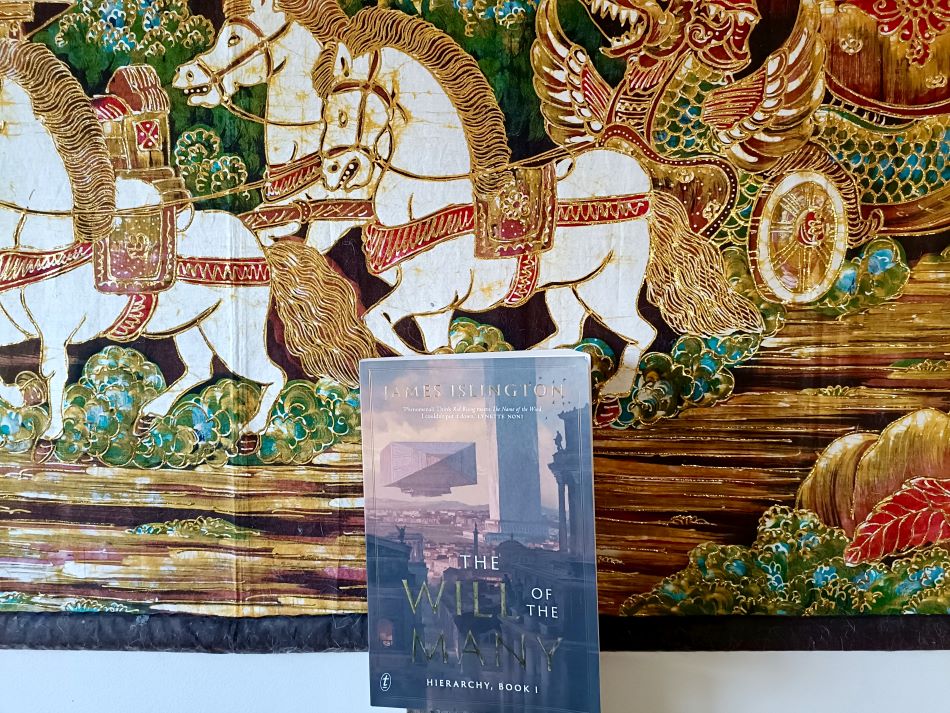
The audiobook, narrated by Euan Morton, is well performed with a hard-to-place accent that made me wonder if it was an Australian narrator performing a miscellaneous British accent or a British narrator performing a miscellaneous almost-Australian accent (apparently the latter). While the audiobook was a great way to immerse myself in this story and rush through it apace, I did end up feeling that there was enough meat in this book to warrant reading in its physical form, which allows for slowing down, taking in details and ensuring no small piece of information is missed. When I inevitably revisit this book, it will most likely be in hard copy format. If you’re wondering why the cover photo shows a hard copy book, it’s because I rushed to buy a copy as a birthday gift ‘for my husband.’
I sometimes worry that I’ve destroyed my reading-for-pleasure ability by over-developing my critical reading faculty, so I couldn’t be more pleased to be struggling to find fault with this book.
Yes, our hero boy-prodigy is uncommonly heroic: some readers take issue with his exceptional academic, athletic and problem-solving abilities, combined with his unerringly noble and courageous deeds. This is probably the biggest nod to The Name of the Wind , but in both books I’m inclined to forgive this slightly tongue-in-cheek protagonistic infallibility, self-reported (both stories are told in first-person) with perhaps an extra seasoning of young male egotism. It’s just a little more disbelief to suspend, and, with neither trilogy yet complete, pride may be a good setup for an interesting fall.
The book is long, which is often a sign of fat that should have been trimmed. I have become much more suspicious over the years of the ‘longer the better’ mantra I once held, but in this case I chewed every chapter with relish. So often lately, even with books I’m largely enjoying, I find myself racing towards the end as they start to sag or stale and wear out their welcome.
The Will of the Many was a beautiful nostalgic trip back to simpler times when my biggest existential worry was that at some point the book would be over and I’d have to close the covers and return to real life, feeling desolate.