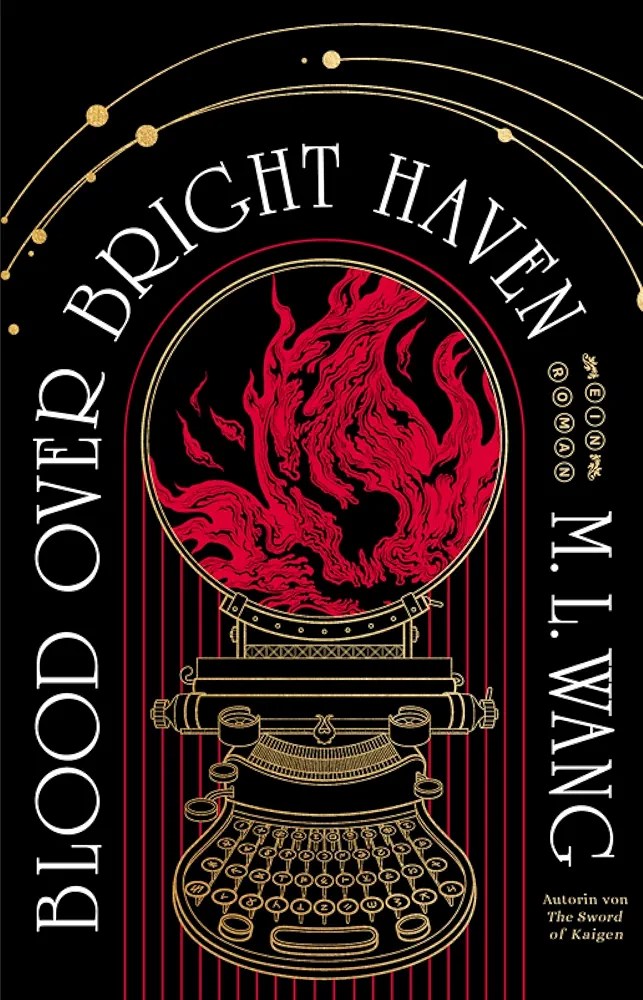

Audiobook narrated by Moira Quirk
‘Do not fear the forces of darkness, for God, who promised us this land, is with us – and his will is light.’
Religion is truly the opiate of the masses in this standalone dark academia fantasy from M.L. Wang – the first work of hers and possibly the first (originally) self-published novel that I’ve read. In fact, although Wang seems to have achieved widespread fame and success, Blood Over Bright Haven is the first of her novels to be picked up by a traditional publisher.
Sciona is a dedicated graduate student who seeks to become the first ever female High Mage to be admitted to the Academy. You might call her obsessive, but of course that is what drives her to go where no woman has gone before.
This is a world of distinct haves and have-nots: the colonists and the displaced. Sciona, a mage of unusual talent who has lived all her life in the city of Tiran, is firmly seated among the ‘haves’. Thomil, a refugee from a nomadic tribe beyond the magical barrier of the city, exists on the other side of the coin, having fled from the terrible Blight that ravages his homeland. Thomil’s people, The Kwen, are second-class citizens in Tiran — objects of self-congratulatory charity at best, and walking cockroaches at worst. The book alternates between the two viewpoints, although Thomil never quite feels as much a protagonist as Sciona.
The combination of magic, academia and fervent religiosity in this story is an unusual one, especially as the magic here is more akin to a science than to traditional magic of the witches-on-broomsticks kind.
Even within the Academy, the bounds of knowledge are set by religious doctrine based on the teachings of Tiran’s founders. The idea of the academic study of magic (which might as well be science as it runs the trains, turns on the lights and boils the kettle) being underpinned by hardline religious belief is initially jarring. But throughout history scientific understanding has often been constrained, either by religious dogma or by the prevailing theories, politics and groupthink of the day.
As her studies take her in an unexpected direction, Sciona is forced to confront the unquestionable tenets of faith on which her beloved magic system is based. The sexism and discrimination Sciona faces, the way truth brushes up against convenience and doctrine, the comfortable city life enabled by a servant underclass, and worst of all, the truth she uncovers, all contain clear parallels with our own world — which is the book’s strength and also its weakness.
When Sciona tries to raise the alarm, she finds that her fellow mages and citizens of Tiran have a strong incentive to keep their blinkers firmly on. If they can choose comfort here at the expense of destruction elsewhere, or destruction here to buy comfort elsewhere, the choice is tragically simple.
The greatest success of Blood Over Bright Haven, the way it got under my skin, was the way in which the story reveals us to ourselves. Reading it, I had the same queasy feeling I had reading The Hunger Games, when the tributes from District 12 attend a fancy dinner party in the Capital at which vials of potion are provided to induce vomiting so the partygoers can fill themselves with food, then empty their stomachs and keep on eating. In this scene we feel the horror and disgust of the tributes, who have grown up one step from starvation, while the Capital takes their produce and taxes them to oblivion. And we also feel the disquiet of thinking that the potion sounds pretty good and recalling Christmas dinners where we’ve had to lie down clutching our overfull stomachs, while political and economic forces not unlike those in The Hunger Games ensure that others in faraway countries are experiencing hunger, malnutrition and preventable disease.
In both books, the brilliance is in the just-subtle-enough: making us hate the oppressors for their cruelty and indulgence and selfishness, before the light shifts and the mirror is angled slightly to reflect the image back on ourselves.
In other areas, though, Blood Over Bright Haven falls a bit flat. While we can in part forgive the heavy-handedness of the feminist messaging because Sciona is living in a world significantly less progressed than ours on gender equality, it does sometimes feel like the hammer is striking this gong a little too loudly.
Similarly, there is lacking subtlety in some of the character portraits, interactions and dialogue – particularly the largely interchangeable ‘arrogant male scholars’ of the Academy. The conflict between 27-year-old Sciona and her colleagues feels more like schoolyard rivalry and bullying than the passive-aggressive subtle undermining and power games that haunt professional workplaces. And while I’m labouring on the complaints, I felt that the world, while compelling, was underdeveloped so that I never quite got a strong picture of it in my mind.
So are there weaknesses? Yes, absolutely. Were they enough to slow my compulsive consumption of this book? They were not.
My only major complaint (and it is quite major) with Blood Over Bright Haven was the ending. Endings are hard. So are beginnings and middles, of course, but so many excellent stories have been ruined by bad endings, there is clearly something singularly difficult about tying all the pieces together in a way that feels satisfying but not trite. This conclusion felt like a rushed attempt to write a certain kind of ending regardless of how it fit with the plot or the internal logic of the story. One comment I read online suggested that the ending didn’t work because the real-world problems highlighted in the book have no clear solutions.
I think this view is valid, and may have been an area where the parallels with reality let the book down. Perhaps we seek refuge in stories because they simplify the bewildering complexity of life; they make the impossible achievable, let the underdogs win with statistical improbability, and persuade us that evil can be overcome – and indeed, easily identified.
Disappointment aside, I binged this book, listening over consecutive days as I gardened, cleaned, walked and hung out washing. The narration by Moira Quirk is solid but a tad drone-y, with a tendency to overdo character voices which I think may have exacerbated some of the weaker dialogue. I did feel, as I often do, that it was a shame this book didn’t get one more draft to polish it into the gem it should have been. Nevertheless, it seeped into my bones and stayed with me after I finished (which didn’t take long).
After a string of disappointments, I was thrilled to finally find a fantasy book I could sink my teeth into. Blood Over Bright Haven is not by any means perfect, but it’s (mostly) very good. I finished hungry for more: Wang’s previous book, Sword of Kaigen, is next up on my list.


Leave a Reply