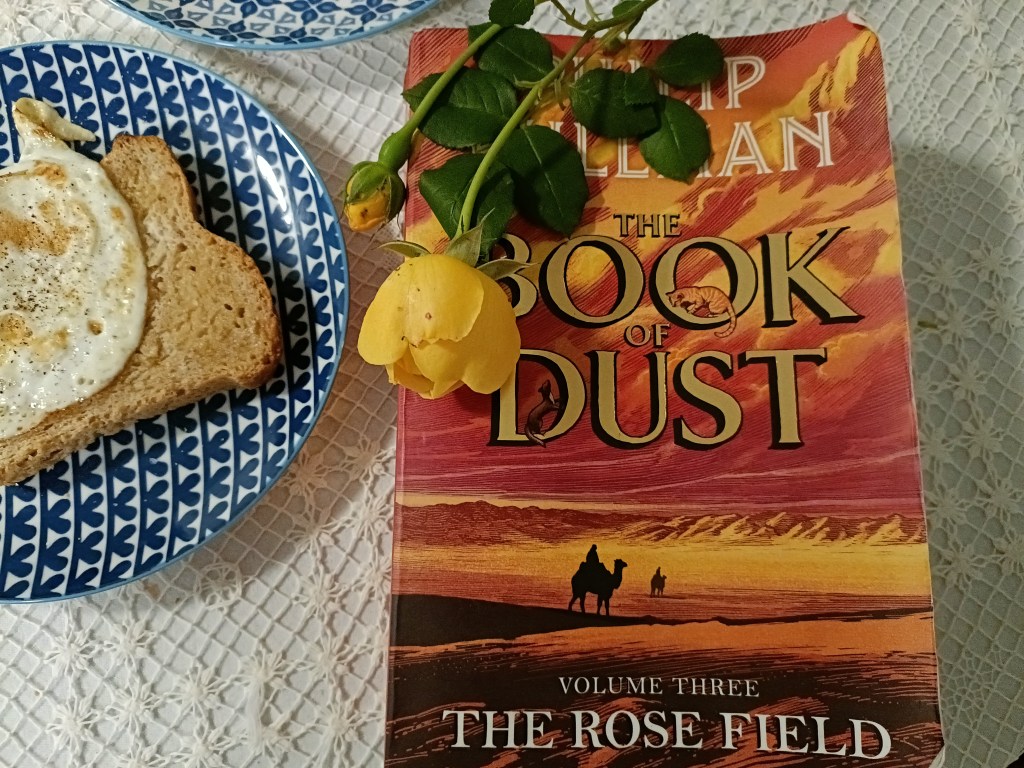

The Book of Dust Book 3
“Almost as If everything beautiful was in another world, and there was a doorway, and if I could only find it…”
The Rose Field is the long-awaited conclusion to Philip Pullman’s Book of Dust trilogy, which follows on from His Dark Materials, the original epic fantasy/science-fiction trilogy that earned a place in hearts and bookshelves around the world over two decades ago.
It’s impossible for me to discuss The Rose Field without situating it among the other five books in the series. Some (much) contrast and comparison and contextualisation is required – please bear with me.
His Dark Materials follows eleven-year-old Lyra, who lives in an alternate universe much, but not quite, like our own. On gypsy river boats, the broomsticks of witches, the back of an armoured bear and the basket of a Texan aeronaut’s balloon, Lyra ventures all the way to the North Pole and into another world – where she meets Will, a fellow world-traveller from our own universe.
As they travel between worlds together, they flee soul-sucking Spectres and befriend quadrupedal animals on wheels. They lead a march of the shadowy dead out from a purgatorial underworld and team up with fallen angels to do battle with the ultimate Authority. Flitting amongst all of this are Lyra’s own brilliant and terrible parents, partially estranged from her and each other, each pursuing their own academic obsession in parallel or perpendicular to Lyra’s endeavours.
His Dark Materials is an exploration on the nature of consciousness, the perils of religion and the possibilities of the many-worlds theory of quantum mechanics. There is a lot going on, to the point where I imagine most editors would throw up their hands and cry, ‘Leave the kitchen sink behind!’
Despite this, or because of it, I would go so far as to call it a perfect trilogy. Notoriously difficult as it is to satisfactorily end a fantasy series, this one has an ending of such bittersweet beauty as hasn’t been seen since Frodo sailed off to the Undying Lands on an elven ship. The level of brilliance required from Pullman to perfectly achieve such an ambitious endeavour is nothing short staggering.
If you haven’t read this trilogy (Northern Lights, The Subtle Knife and The Amber Spyglass), go and do so immediately. I promise it will enrich your life. If it doesn’t, the Spectres must have got to you already. You’ll likely find it in the children’s section, but in my many re-readings since I first devoured it in my early teenage years, I’ve found new meaning and points of reflection every time. It’s one of those books that offers a page-turning magical adventure for young readers and philosophical contemplation (plus the page-turning magic) for older ones.
After all of this preamble, we finally get to The Book of Dust, the second trilogy, of which The Rose Field is book three (I hope you’re keeping up). Seventeen years after the final installment of His Dark Materials, we got La Belle Sauvage – a prequel featuring Lyra as a baby, in which we see the origins of political and religious machinations in her world that drive much of the original trilogy.
The second installment in The Book of Dust (trilogy #2) is The Secret Commonwealth, which jumps forward twenty years to Lyra as a young woman, having returned to her own world to a relatively normal and uneventful life. Ten years on from The Amber Spyglass, we meet her as a shadow of her former fiery self: bored, cynical and a bit depressed.
The spark of magic was dimmed not just in her, but also seemingly in her whole world. So brimming with wonder and surprise in Northern Lights and still in La Belle Sauvage, the world of The Secret Commonwealth and The Rose Field is much more subdued, much closer to the humdrum nature of our own world. The armoured bears and aeronauts have retreated, giving way to electric vehicles and corporate takeovers.
In The Secret Commonwealth, Lyra’s daemon (spirit-animal), Pantalaimon, leaves her and embarks on a solo journey to Central Asia in search of what he claims is Lyra’s lost imagination, and of course she must go after him. Malcolm, the young protagonist of La Belle Sauvage, who delivered Lyra to safety in a great flood, plays a starring role here, despite having never appeared in the original books. He sets off after Lyra to bring her safe home once again.
Caught up in it all is another young man seeking vengeance, determined to hunt Lyra down, and it’s all set against a dangerous political backdrop in which Lyra and her friends are operating as dissidents in a world of religious authoritarianism.
While La Belle Sauvage didn’t live up to the brilliance of the original trilogy, it felt like another excellent adventure story in the same universe, though it leaned rather than built upon the themes of HDM. The Secret Commonwealth was a little more sedate, perhaps overly philosophical, a little plodding. I found it flawed but enjoyable, with a strong-enough story, and all the strengths of the original world, characters and ideas. The Secret Commonwealth ends with Lyra alone in the desert of Karamakan, searching for Pantalaimon and the imagination she’s lost.
I was so looking forward to the final chapter in the story that when the coronavirus pandemic arrived, I clamoured for the author, who was by then in his mid-seventies, to be locked up in quarantine under armed guard with only pen and paper and daily food rations while he finished the last book.
Finally, in late 2025, The Rose Field was published.
This final chapter picks up exactly where its predecessor left off and sees Lyra travelling into Syria and picking up a charming rogueish travel guide before meeting up with Malcolm in Aleppo. Pantalaimon, Lyra’s daemon, and Malcolm find themselves captured by gold-obsessed gryphons in a mountain tower and form an alliance with the witches to take on the Magisterium, a religious political body which has set about to destroy the entrances to other worlds.
How all these plot lines connect is something of a mystery. Each time a new thread is started, there’s a sense of intrigue and excitement around how it will tie into the existing narrative and world. Sadly, most of these threads, some started in The Secret Commonwealth and some picked up fresh in The Rose Field, seem to get forgotten about and left on the cutting room floor.
I’m doing my best here to avoid a full-blown rant about every plot line in The Rose Field that never got resolved. There is another side plot involving the resistance movement Lyra and Malcolm are part of, but this gets dropped about three quarters through and never seems to achieve anything.
In His Dark Materials, Pullman shows himself to be capable of plot-mastery, but he fails to live up to it in the last two books of this second trilogy, and in The Rose Field most of all. You can almost feel, at times, the author’s dot points: ‘this must happen so that this can happen next and so that I can make this point about that.’
Lyra’s ‘lost imagination’ is a core theme in The Secret Commonwealth and The Rose Field which never quite worked for me as a propulsive plot device. The journey through Central Asia is evocative but always somehow feels driven more by narrative necessity than by causal events and motivations that make total sense within the world of the book.
If Philip Pullman has a weakness as an author to counter his many strengths, it’s a tendency to be a little didactic. He reigns it in to a surprising extent in his novels, considering how controversial he can be in interviews, but the author’s strongly held opinions do sometimes peek through the page. In these last two books it feels like his editorial leash has been slackened. The books get longer, but not better. In fact, by the end of The Rose Field it felt like Pullman had broken the leash altogether and run off solo to howl at the moon. He claims he revisited Lyra’s story after all these years because it hadn’t really finished. But it felt in this final book like he wrested the story away from his protagonist and turned it into a vehicle for a personal political diatribe.
The characters we came to love in His Dark Materials are mostly forgotten in this second chapter, replaced by (ironically) much more forgettable supporting characters, who never seem to have much to do. The exception is Mr Ionides, Lyra’s roguish travel guide, who is totally charming but whose role in the story ultimately feels tangential.
Lyra as a young woman lacks a lot of the spirit and sense of fun she had as a girl. This is in part what drives the story in these last two books – she must reclaim her lost sense of self – but it does mean that as a character she’s a little less charming company than she was in the first three books. This same goes for Malcolm the man. While there is nothing especially wrong with him, herein may lie the problem. He’s solid, steadfast, learned, capable and infinitely sensible. In other words, he’s a bit dull.
Taken at face value, the majority of The Rose Field is an enjoyable-enough story. Pullman’s scene-by-scene writing is mostly as excellent as ever, though a little rough around the edges in parts. The pacing is particularly poor, some of the dialogue overly expository and at times he seems to even lose control of the omniscient point of view.
Most of the way through, I felt The Rose Field was still a few drafts off a great book. Once I read the final page, I was in disbelief that the author would spend so much time and creative effort only to give the least satisfying possible resolution to a story he’s been immersed in for two decades.
As a book, the sum of its parts is good enough, and even holds much promise. The whole is a giant mess, especially when considered as half of a 1200-odd page story, spread over two volumes (considering this as a continuation of The Secret Commonwealth) which never goes anywhere.
If the narrative journey of Northern Lights could be likened to a mad dash on a snow sled culminating in a leap over an icy gorge, that of The Rose Field feels more like an aimless wander through a rose garden, during which occasionally you start sprinting towards something, only to run into a thicket of brambles and thorns which require a lengthy extrication process. The action moves forward at pace, then grinds to a halt as important plot points are revealed through long and plodding conversations. The next thing that happens will feel more randomly chosen than preordained. By the end, I felt that Pullman had fallen into a bramble so thick he couldn’t cut his way out. He clearly had many ideas but didn’t seem to be able to figure out how to tie them all together and it feels like, despite the long writing process, this book was rushed to publication way before its time.
The conclusion we waited twenty years for could not be further from the exquisite ending of His Dark Materials that broke so many hearts.
The ending of The Rose Field blows open plot holes the size of the Grand Canyon, drops characters by the wayside, cuts off every narrative thread and basically makes everything that came before it seem entirely pointless. It could be said it leaves plot holes large enough for a million soul-sucking Spectres to float through. Worst of all, it undermines and contradicts much of what happened in the original trilogy – especially the bittersweet conclusion – and makes us wonder what it was all for.
I heard Pullman say in an interview that he rewrote the ending about eight times as his editor kept telling him it was no good, and he claimed the ending was much better for all the rewrites. What those alternative endings were, we may never know, but it’s hard to imagine anything worse than the one we got, which I can only imagine was a result of compromised creative visions, fatigue and compressed publication schedules.
Of course, in my rage and disbelief once turning the final page, I immediately turned to the wisdom of Reddit and found some small solace in the outpouring of frustration from other readers over the plot holes, side quests, discontinuities and disservices to the original story and felt similarly let down by this (lack of a) conclusion. It’s rare that an ending can be so dissatisfying as to almost make you want to erase the whole book (or books) but The Rose Field comes pretty close.
Avid readers of His Dark Materials waited two decades for this final installment to give our beloved Lyra’s story a continuation worthy of its beginning and the resolution she deserved. It didn’t have to be a happy ending, but it should have been a story worth telling.
The quote at the top of this post hit hard for me: the character is describing unearthly music heard in another world through a portal he could never find. I spent much of my young life believing that everything beautiful was in another world. I went through doorway after doorway in search of it. It took a long process of growing up to learn that beauty was in front of me all along – including, but not in any way limited to, wondrous creations of the imagination.
But Philip Pullman created one of the most beautiful otherworlds I ever had the fortune to escape to. To pick up the story after all these years only to finish it in such a way as to make the whole six-book-long endeavour seem pointless felt like setting a bomb to this wondrous creation that meant so much to so many. This is, of course, a childish attachment to what is ultimately just a set of books. But I’m sure the author would agree that putting away childish things entirely is no good way to grow up.
Ultimately, I salute Philip Pullman on creating not just one but three perfect books. His Dark Materials has given me so much joy, so much contemplation, over the years. I even read some lines from The Amber Spyglass at my wedding. I wish him only the very best in his well-earned retirement from creative life. (Please, Philip, no more.)