
‘In the high Himalayas, it is often the case that climbers find themselves being accompanied by the ghosts of those who failed in the attempt, or the sadder, but also prouder, ghosts of those who succeeded in reaching the summit, only to perish on the way down.‘
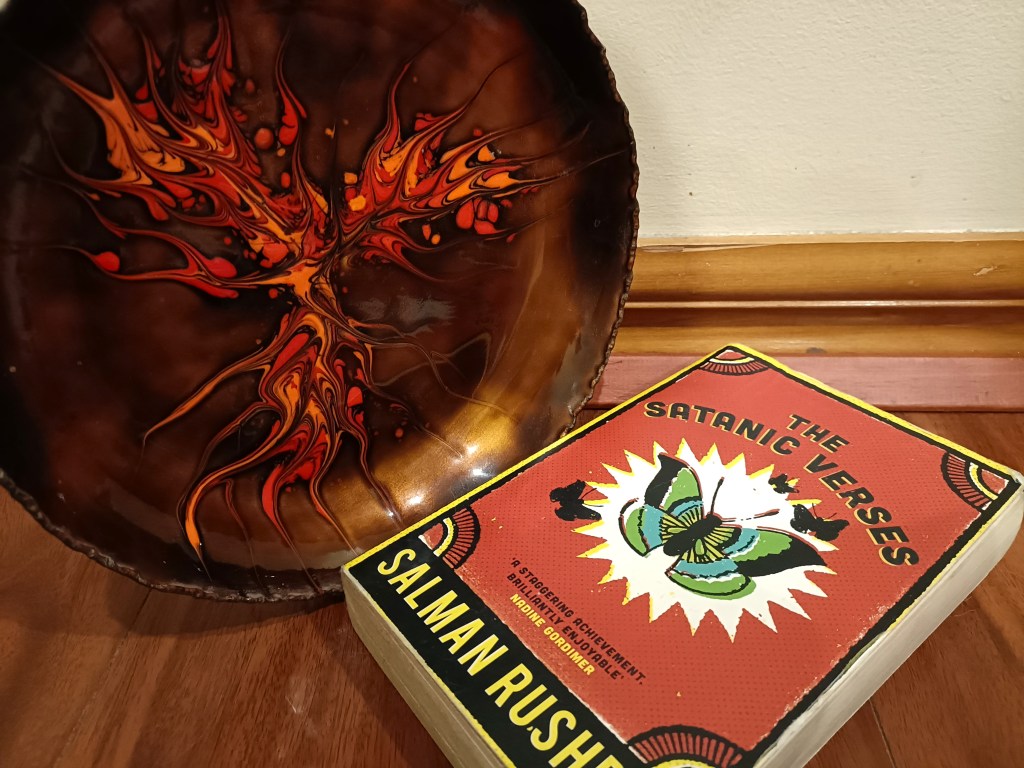
I picked up this book some time after the 2022 attack that left the author seriously injured and blind in one eye. Kudos to the bookseller at the Alice Springs bookshop for pulling it out, dusting it off and placing it prominently on the shelf almost four decades after its publication. After the knife incident, buying the book felt like the tiniest act of resistance against the terrorism of murderous thin-skinned religious zealots.
The story of the fatwa issued against Rushdie for writing this novel, and the ten years he spent in hiding as a result, is fairly well known. Less well publicised were the attacks and murders of the book’s publishers and translators in various countries, including the massacre of 37 people by a Turkish mob.
Rushdie has been one of my favourite authors since I read Midnight’s Children in my early twenties, and a bit of a personal hero for his determined and courageous response to the threats and acts of violence against him, and his enduring commitment to free speech in the face of it all. Midnight’s Children remains my favourite of his books so far, but I’ve enjoyed all the ones I’ve read: The Enchantress of Florence, East West (a short story collection) and Haroun and the Sea of Stories (a children’s book, I realised belatedly, but a delightful read). I have a couple more on my eternal shelf.
As such, I was excited to read The Satanic Verses – and surprised to find it a bit of a struggle. I also loved it. And I also wished it were half as long. It is a sweeping, grandiose, chaotic, absurd adventure that is at times enthralling and mind-blowing and at times a bit of a drag. It is a masterpiece, of some kind. This will be a review of conflicted emotions.
How to summarise what this story is about? It starts with a Bollywood movie star and a (less famous) voice actor falling out of a hijacked aeroplane over the English channel after the aircraft explodes. In Rushdie’s signature magical realist style, the two British-Indians jumble in the air in a tangle of limbs before hitting the ocean and swimming to shore, their destinies now inextricably linked.
Bizarrely, around the time I was reading this book, an Air India plane crashed after takeoff and, in an almost equally unbelievable twist of fate, one passenger – a British-Indian man – survived the wreckage, walking away with no major injuries. A haunting stranger-than-fiction parallel that makes me wonder if the world isn’t a little more magical and unpredictable than we give it credit for.
Another storyline in the book follows the fictional prophet Mahound, who ascends Mount Cone to hear the voice of God, only to later become convinced that the words were in fact whispered to him by the devil, Shaitain. The one who whispers the verses is in fact the Angel Gibreel, sort of played by Gibreel Farishta, the movie star who fell out of the plane and acts sometimes in the role of an archangel while Chamcha, his co-survivor, grows devil horns and becomes poisoned with envy over Gibreel’s more successful career. Another storyline follows Alleluia Cone, a mountain climber who remains haunted by her conquest of Everest and cannot help, in between summits, falling into a tangled relationship with Gibreel, the sometimes-angel, who resembles more of a man-child in his waking life.
This web of insanity is largely set against the backdrop of a racially intolerant Britain as our heroes, Chamcha and Gibreel, must navigate the new ‘immigrant alien’ identities cast upon them by virtue of having washed up on the country’s shores instead of landing at Heathrow.
After you recover from typhoid, Chamcha reflected, you remain immune to the disease for ten years or so. But nothing is forever; eventually the antibodies vanish from your blood. He had to accept the fact that his blood no longer contained the immunizing agents that would have enabled him to suffer India’s reality.
All of this makes for rich, and sometimes exhausting, reading. Knowing that Rushdie was inspired by his interest in ancient Islamic texts, and knowing very little about Islamic culture or theology myself, I felt in some ways unqualified to fully comprehend all the meaning contained in the characters, names, references and interlinking stories. I happened to read it around the same time as Rory Stewart’s memoir, The Places In Between, in which he notes that Islamic texts often begin with a contradictory construction: ‘it happened and it didn’t happen.’ It makes it hard to ascertain the literal truth of historical texts, but seems to imply that the story is true in the only sense that matters: it is story-true. This is a perfect allegory to magical realism, and the ‘it happened / it did not’ construction is one Rushdie uses often thoughout The Satanic Verses. I wondered how many other such nuanced references I missed out of ignorance.
Salman Rushdie is one of those witers who both inspires me to write and fills me with despair by comparison to his brilliance. I hate to use the word ‘genius’, especially about yet another man, but it’s hard to describe the mind of this author any other way.
The Satanic Verses is incredibly impressive, but I’d say it’s a bit more impressive than it is enjoyable – in fact, it’s kind of hard work. I read another whole book in the middle of it for a reprieve (see Once There Were Wolves) and fell asleep on three consecutive occasions trying to read one sentence that spanned most of a page. The hard work is rewarded with scenes of unrivalled creativity and sentences of sublime beauty. Among those highlights is stopping every couple of pages to look up a word in the dictionary, rereading neverending sentences to try to unravel the meaning, and sometimes feeling that the core of the story remains elusive for all the profusion of words.
I’ll admit that the longer the reading experience went on (and it went on for a while) the more it started to feel like a chore. While I still enjoyed each reading session, a few pages generally left me sated instead of hungry for more – and there are a lot of pages in this book. Towards the end I was feeling that I had scaled the peak of the book some time ago, and was now just trying not to perish on the way down.
This left me with the strange experience of wanting to defend The Satanic Verses as an excellent book, yet reluctant to recommend it to many (any?) of my book-loving friends and associates. As I like to do when perplexed by a book, I sought the wisdom of Goodreads and Reddit, and found a similar sentiment among Rushdie enthusiasts that this is far from his strongest work.
So I guess my advice would be to read all his other books first and if you love them, read up a bit on your Islamic culture and religious history and your Indian culture and your 1980s British politics – and make sure your general history and philosophy is all up to scratch. And then come back and enjoy this book to its fullest extent.
As to the mobs and zealots, I confess I came away with no strong understanding of what the religious fuss was all about. Rushdie asserts that the vast majority of the book’s opponents have never read it, and this seems highly plausible. If they had tried, they’d likely still be buried in the dictionary, scratching their heads.

