
‘I feel sometimes it is so difficult to be conscious… and I think that anything would be easier. Anything at all.’
‘There’s time for that.’ Peter grasped her by the elbow; firm, but gentle. His voice was soft. ‘It’ll always be waiting, Law. But we’ve got things to do.’
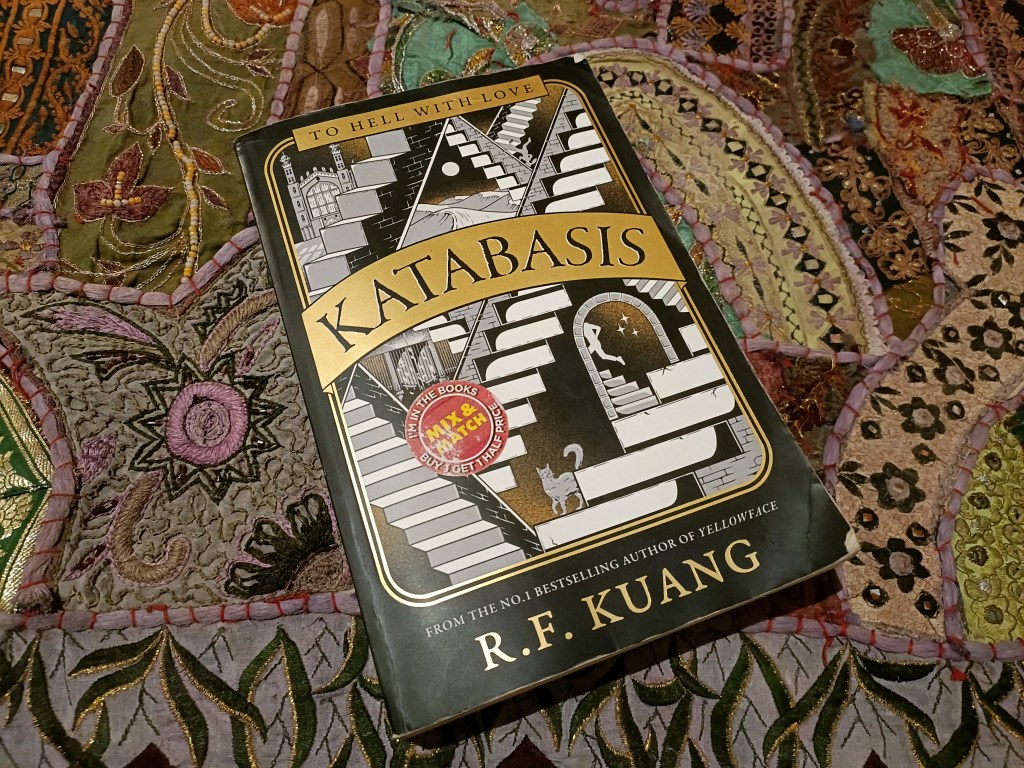
I knew the name R.F. Kuang from her 2023 novel Yellowface, which caused a big stir but felt too tapped into the political zeitgeist to pique my readerly interest. It was only recently that I learned her primary genre is actually fantasy. Having heard positive reviews about her novel Babel, I picked up Katabasis with interest when it ended up in my luggage as the result of a buy-one-get-one-half-price deal at the airport.
It should also be said that Kuang is a ridiculously successful writer and person, who published her first novel at 22 and has now, at the ripe old age of 29, published six novels, with more in the pipeline, and earned herself a Nebula and a #1 spot on the bestseller list of the New York Times. Somehow, while becoming a prolific bestselling novelist, she has earned two Masters degrees and is on her way to a PhD at Yale. These facts alone might be enough to compel you to pick up one of her books, and from the beginning of Katabasis there can be no doubt that it’s written by a very clever author.
Some combination of fate and algorithms led me into the dark academia genre, as it often has of late, with this tale of two graduate students on a jaunt through Hell to retrieve their recently deceased thesis advisor. Alice and Peter are fellow students in the Academy of Analytic Magick, specialising in linguistics and logic respectively, and it’s clear they have a history to be teased out.
A journey through the underworld for the sake of a PhD sounds like a fun premise, and in fact journeying through Hell and back and sacrificing half a natural lifespan seems to function as a fitting metaphor for the process of obtaining this notoriously gruelling credential.
Katabasis has a lot to say on the state of academia, the tendency of advisors to steal their students’ work, and the role of women within this system that infamously lags behind modern expectations of gender equality. Kuang’s biting, satirical commentary on the quirks of academia and elite universities is fun to read. There is some excellent and nuanced exploration of femininity, sexuality, sexualisation and what liberation means. Desiring to be desired, without desiring back, for instance, or desiring the freedom to flirt with one’s professor, free of the obligation to sleep with him. But the backstory about campus life (which accounts for about half the book) is told as highly narrated flashbacks, which gives it all an unfortunate sense of emotional remove.
Even so, the university is where most of the interest lies, whereas the Underworld is, ironically, a bit of a drag. Kuang’s vision of Hell seems more closely modelled on the endless trek to Mordor than on the fiery pits of Mount Doom. Alice and Peter wander through the eight courts encountering a big wall, some violent bone-piles and mostly vague and uninteresting dead ‘Shades’, but nothing for the most part to cause much concern. In fact, there was so much of nothing in Hell that when real peril did come knocking, I was too surprised to process what was happening.
There’s a lot of wit here: Hell in fact takes the form of a university campus, where Shades spend centuries in a purgatorial state, writing essays examining their sins in the vain hope of being granted reincarnation by unknown and unseen deities, putting off a permanent ending to existence. They fuss over minute details of philosophical argument, spending decades trying to get the wording just right, only to acknowledge that they have never seen anyone actually pass this test or receive any feedback on their attempt.
Peppered throughout are constant references to philosophy thought experiments, paradoxes and logic puzzles, which play an important role in magick – which seems to mostly consist of drawing chalk circles and imbuing them with some combination of equations and language tricks to make unlikely things occur.
While interesting on their own, these constant references to philosophy probably end up distracting from the story more than driving it. Yes, an obscure thought experiment combined with some magic chalk might be enough to get our heroes out of a sticky situation or two, but ultimately it feels more like hearing an annoying kid in class constantly bringing up Plato and Kant and Heidegger more to show off how much he knows than to add any value to the conversation.
Because most of these concepts cannot be explained in a few sentences, you really have to be already familiar with them in order for the references to mean anything or their relevance to the story to make any sense – which rather narrows the pool of potential readers suited to this novel. And then, if you are familiar with the concepts, they’re not explored in enough detail or with any real novelty that would make them particularly interesting to read about other than nodding and going, ‘Ah, yes, Monty Hall – ah, yes, Pascal’s Wager. Mmm. Indeed.’
Once, in school, I took part in a kind of ‘puzzle-a-thon’ where we had to solve maths and logic puzzles as a team against the clock. Reading Katabasis often felt not like participating in one of these, but like standing watching it through a window and having the puzzle-solving activity described to you.
The story almost suffers more because of all the clever ideas contained within it than in spite of them. The characters never fully came to life for me; the stakes never seemed high enough; the whole concept of magick felt sort of irrelevant. Hell was a bit too sandy and monotonous and the whole thing had some of the feeling of all the late night pub conversations you had with your friends at uni, pulled and pummeled into the format of a novel. It was a much longer book than its contents justified and, while always an enjoyable reading session, ended up being a bit of a grind to get through.
I guess not all magick has that magical feeling, and Hell might just be a place where nothing ever happens. (But yes, I will still be putting Babel on my reading list. And maybe The Poppy War Trilogy, too…)
 The Next Shelf