
‘Death gets under your skin, you carry it with you. People can sense that.’
This was a Christmas book from my father-in-law, who usually chooses well. This book was a particularly good choice for me given the subject of rewilding that forms the basis for the story. In fact, last year I visited the Dundreggan Rewilding Centre in Scotland, which gets a mention in the book, and the Cairngorms, where the story takes place, and will happily chew anyone’s ear off about nature, conservation and rewilding.
The second offering from Australian author Charlotte McConaghy, the story follows Inti, an Australian wolf biologist leading a pilot project to reintroduce wolves to the Scottish highlands as part of a rewilding effort to naturally control deer populations and restore the balance of the forest ecosystem.
By some coincidence, this was the third book I read this year dealing with rewilding in the UK. The other two were both non-fiction books that approached the subject from opposing perspectives. The exploration of the topic in a fictional setting was a fascinating blend of the two, because of course nothing is ever so simple in the land of stories (which is to say real life).
Inti is more an animal-person than a person-person – prickly, brusque, call-a-spade-a-spade – and we follow her as she ricochets around this small rural Scottish town raising eyebrows and making enemies among the local farming population who see the wolves as a threat to their livelihoods and maybe even their lives.
McConaghy is undoubtedly a talented writer and Once There Were Wolves had more than enough plot and intrigue to keep me engaged – almost too much plot and intrigue, perhaps.
I read this as a side-quest halfway through Salman Rushdie’s The Satanic Verses after one more late-night reading session in which I found my eyes and my brain simply unable to follow the complex, chaotic magic-realist world. I found myself picking up this book four times out of five over that one until I’d finished it (I’m still only two-thirds through The Satanic Verses). Who among us hasn’t succumbed to the allure of a highly readable book with an intriguing yet simple plot over an undeniably better book that takes up much more brain power?
Yet it would be deeply unfair to paint this as a mindless page-turner. There’s some beautiful writing and thoughtful consideration of her topics and themes. There is much darkness, which is a big part of its eerie appeal. The wolves aren’t the only danger lurking in this place. Violence is a consistent theme and McConaghy is an expert at foreshadowing and revealing just the right amount at just the right time to keep me absorbed and turning the pages.
As with a lot of the new Australian fiction I read, I felt that in parts a talented writer was let down by inadequate editing. Parts of the novel read like a near-finished draft to me. Side characters often felt like cut-outs and lengthy passages of expositional dialogue fell flat. I felt there were scenes that should have been summaries and summaries that should have been scenes. I was surprised to learn that McConaghy actually studied screenwriting, especially as I thought the descriptive prose was the strongest aspect of the writing and the dialogue the weakest.
I wanted more Scottishness from the book, more culture clash, more sense of the place as somewhere Inti didn’t fully understand. It was easy to forget where we were, though the rural highlands setting and Inti as an outsider had promise to be one of the book’s draws.
I wanted less explanation of rewilding and forest ecology for the reader. While the uninitiated would be going in cold and may appreciate some of this, readers who already understand the basic concepts and arguments will probably skim these passages as I did and wish the author had found a niftier, subtler way to ‘educate’ the reader on the topic as required without making her characters give each other the 101 in awkward monologues.
Still, sometimes I worry that studying the craft of writing has made me pick things apart that once I would have breezed over. I just came away with the sense that this was a great book that deserved to be a little better.
As the plot develops it twists and turns, accelerating towards the finish so fast you’ve barely turned a corner before the next curve hits, taking you in another direction. By the end I wasn’t entirely sure what I felt about the resolution and the many revelations, but I appreciated the wild ride. As to whether I’d read another book by this author, once I sink into the first page, I’m guessing I won’t be able to help myself.


Responses
Hear hear! What are Australian editors doing? Sometimes it’s like the book doesn’t go through that process at all.
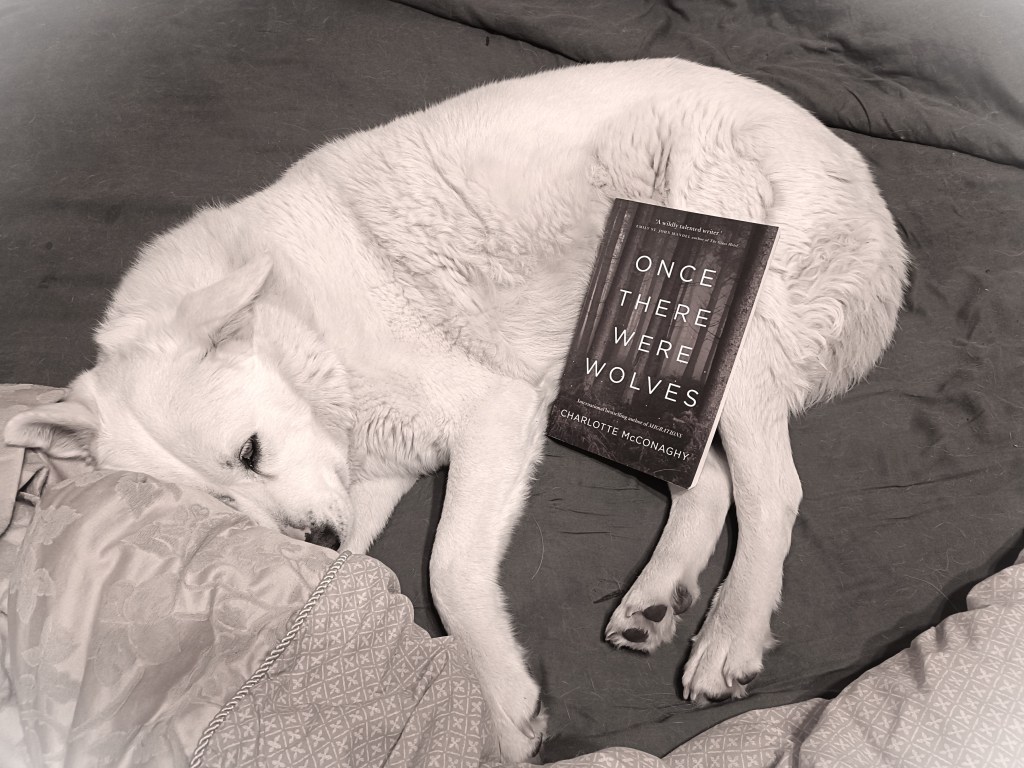
LOVE the photo with Cinna. What a treat. Please don’t rewild Cinna in Scotland!
Interesting pick up that the author was a screenwriter. Poor dialogue in these types of books is very disappointing. By ‘this type of book’ I mean 300 page long – I am guessing at the length here – modern Australian novels that refuse subtlety and rely on dialogue.
I’ll likely wait for the ABC miniseries for this one based on your review. Her new book has been getting good reviews so hopefully she’s improved.
Happy Easter!
Ps Fatherinlaw book presents are always fun.
LikeLike
Yes, I suspect it’s all about economics. Having had a couple of stabs at writing novels, I can say it’s a ridiculously difficult endeavour and even books with good bones likely often need a LOT of editing to reach their true potential. I’m guessing that there just isn’t the money in the Australian industry to give the amount of time and attention that’s really needed to the editing process. It’s always a shame when you read a good book that just needed a bit of polishing, but having said that I still found this a really engaging read overall. Oh, and I think Cinna would love to be rewilded in the highlands for a few hours – until she feels like coming back to curl up on her queen bed.
LikeLike
Can the authors not edit their own work? I would have thought part of writing multiple drafts would be to address structural issues like dialogue. Surely the author knows it is a problem, as good authors generally should be good readers too.
LikeLike
For sure there would be multiple drafts but as the author sometimes you’re too close to the work to see clearly what is and isn’t working well. I wonder if someone trained as a screenwriter just has a higher tolerance for expositional dialogue as well, because in film you don’t have too many other tools available – although you still need to figure out how to be somewhat subtle about it.
LikeLike