
“There was an emptiness to her. A sense her lack of affect went all the way down.”
As usual, I’m in catch-up mode. It seems to be a rule of getting older that time passes more quickly each year, so I shouldn’t have been so shocked to find that the Christmas book I was finally getting to was not from last Christmas, but two Christmases ago.
As part of the annual Christmas shopping assignment, I had perused the Booker Prize shortlist for the year in search of compelling titles for the people in my life who are destined to unwrap only books from me, year after year after year. It’s now reached the not-unhappy point where the recipient bookshelves are so overflowing, I sometimes receive the book back immediately after it’s been read. Have I cracked the Christmas code? I think so.
- Spend time reading about books
- Spend time in bookshops, buying books
- Avoid any form of online shopping or crowded malls
- Receive the gifted books back as freebies, to stack on my own overflowing shelf
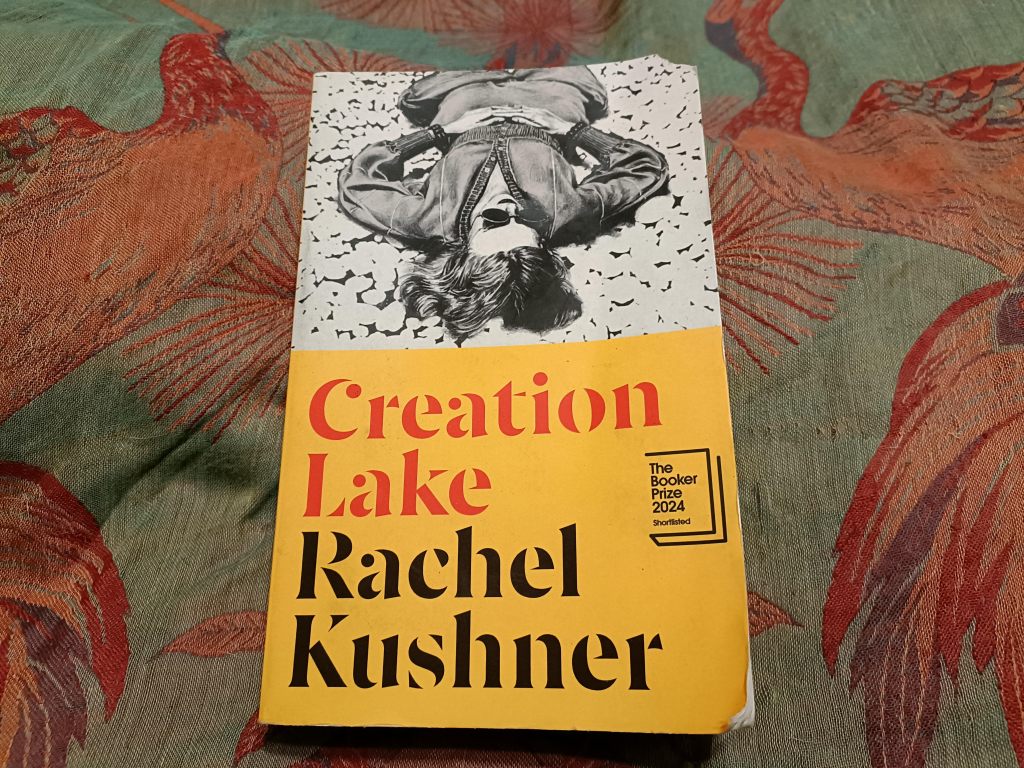
While I didn’t find anything in the shortlist that year that seemed to fit the reading patterns of my intended recipients, Creation Lake caught my attention – it sounded like a fun read, unusually so for the Booker list, which often tends more towards war, famine and broken families. My husband happened to be on the same wavelength, and bought it for me.
So finally I got started on Creation Lake, which had been emanating waves of enticement from my shelf for the last year and a half. The jacket advertises it as a kind of spy novel with some depth: the story of a cynical American undercover agent who is sent to infiltrate a commune of eco-activists in rural France and finds herself becoming seduced by the philosophy she sneers at. What’s not to like?
Well, that might depend on the expectations you hold of the novel form. The jacket is not incorrect, but I did find it somewhat deceptive. The spy novel genre is typified by fast-paced action, tension and high stakes. As a Booker shortlist title, I was expecting Creation Lake to have the tension and drama of a spy novel, combined with the compelling ideas and well-crafted prose that standard genre novels sometimes lack. Ideas and good writing are aplenty in this book; tension and drama, not so much.
An endorsement from Bret Easton Ellis inside the front cover reads, ‘I kept thinking, “this can’t possibly work”, and yet it kept working.’ I can’t say I entirely agree. What I can say about Creation Lake is that I can see it working for some people.
If you’re the kind of person who likes ‘thinking novels’ and doesn’t care too much for character development or plot, you might not mind that there is essentially only one character in the novel. You might not mind spending 400 pages inside the head of jaded, hollowed-out first-person narrator, while peripheral characters flit around the edges and the plot meanders along like a Neanderthal who’s in trouble with his mate and in no hurry to return to the cave.
Neanderthals, or ‘Thals’ are very present in this book, while also being fairly irrelevant. Approximately half the book is made up of emails from a kind of cave-influencer called Bruno Lacombe, who has forsaken the ills of modern life (apart from email) in order to live a solo existence in a cave that contains remnant clues of Neanderthal occupation. He reflects deeply on the early history revealed by the caves and the relics found within, including a focus on the misunderstood Neanderthals, who were surely much more advanced and clever than we vain sapiens want to give them credit for.
Bruno sends long emails outlining his theories on the homos neanderthalensis and sapiens to a commune set up within the ancient Guyenne province in southwestern France. Its inhabitants are seeking reconnection with the old ways, embracing the traditional farming way of life and communal living, rejecting modern capitalism and technological advance.
This is the commune Sadie, our anti-hero, has been sent to infiltrate by her mysterious and shady employers. By hacking into the emails, she’s learning all she can about this group of hippie eco-activists who are opposing a large-scale megabasin in the region that they feel will threaten the rural economy, traditions and way of life. And who must be prevented from causing any trouble to the corporate overlords who have a vested interest in the project going ahead.
There’s plenty to chew on in this story; it’s just somehow not the meat I was expecting or hoping for. The premise as outlined above offers so much, but delivers very little excitement. There is much philosophising on human history, evolution, culture and society; reflections on change and progress, on the inevitable march of technology into these rural communities that still look much like they did in the 1200s, but with petrol cars and iPhones.
There is some excellent observation on class: the core of this commune of radical reactionaries is made up of wealthy private-school boys, who are all too willing to leave the grunt work and childminding to the women while they do the intellectual work in the library, writing theses on the livelihoods of the peasants they, outsiders from the big city, claim to represent, but whose gruff manners and xenophobia (or downright racism) they deplore.
“I kept my face blank, to suppress my amusement. Refined and Parisian Alexandre had never been forced to associate with the sort of lower-class white people who might feel threatened, if misguidedly, by immigrants and nonwhites.”
I enjoyed mulling over these concepts, which are explored through Bruno’s emails combined with Sadie’s sharp observations. But it left me wondering, was a novel really the best form for this book? If the author wanted to write a treatise on human history and culture, on the way technology and progress butt up against rural traditions and our seemingly-increasing desire to retreat to simpler times, this might have been done better in a non-fiction format. I felt I was learning a lot about human and pre-human history, but as told by an unreliable narrator in a novel, and so, as knowledge, practically worthless. As a book, Creation Lake has many strengths. As a novel, it has many weaknesses.
It’s always a challenge to write an unlikeable protagonist. Sadie is basically an empty shell. She sneers at the proletariat and intellectual classes alike. She drinks and drives. She reflects without introspection on the young boy she entrapped and sent to jail in her previous job. She sleeps with a man she despises (for the sake of her cover) and another who is otherwise engaged (just for fun). I agree with Bret Easton Ellis insofar as it’s incredible Creation Lake works as well as it does.
Sadie and the basic plot and the ideas contained within are just engaging enough. There’s never a sense of high tension or of anything much being at stake. Sadie’s observations are humorous, but she’s by no means enough of a riot to be good company despite her failings. Bruno’s emails are paraphrased through Sadie’s reading voice, instead of written out in full, which further intensifies the stifling sense of being trapped inside this amoral, soulless void of a person.
Similarly, there is minimal dialogue. The dialogue that does appear is often either oddly unnatural, over-polished and quip-like, or overly summarised and workmanlike, giving information instead of revealing character or creating tension. Not only does Sadie never get close to anyone, she never even really pretends to. Apart from the expected late-stage change of heart, there is very little character development or relational tension. It’s as if not only the protagonist, but the author herself, is a misanthrope who would rather spend as little time with other humans as possible.
I never felt like giving up on the book, but I did feel frustrated with it – especially when I found myself more than three-quarters of the way through and realised the plot had not progressed at all. Perhaps the best aspect of the reading experience was that, dismayed by my lack of progress, I committed to spending a lot more time reading, so I could get through it faster and onto the next book. I reinstated mandatory bedtime reading, which for too long has been classed as a luxury or an audio-only venture (which basically means rewinding to the same spot every night before immediately drifting off).
I found the more I forced myself to read Creation Lake, the more I enjoyed it. But that maybe says more about the act of reading than the book itself.
I enjoyed the setting in rural France; the book has such a European sensibility it’s hard to believe the author is American (she is also, from her cover photo, the most European-looking American to have ever lived). I enjoyed the philosophising and the snarky commentary and the essentially irrelevant side-expeditions about random local residents and Neanderthals alike.
When I finished, I was glad to have read it, but didn’t feel it justified the opportunity cost of lost reading time for better books. Ultimately, I felt that the novel, like its protagonist, suffered from empty-shell syndrome: it has flesh on its bones, but no identifiable heart.

